
B2B Sales Enablement Services: The Executive Guide to Scaling Revenue in 2026

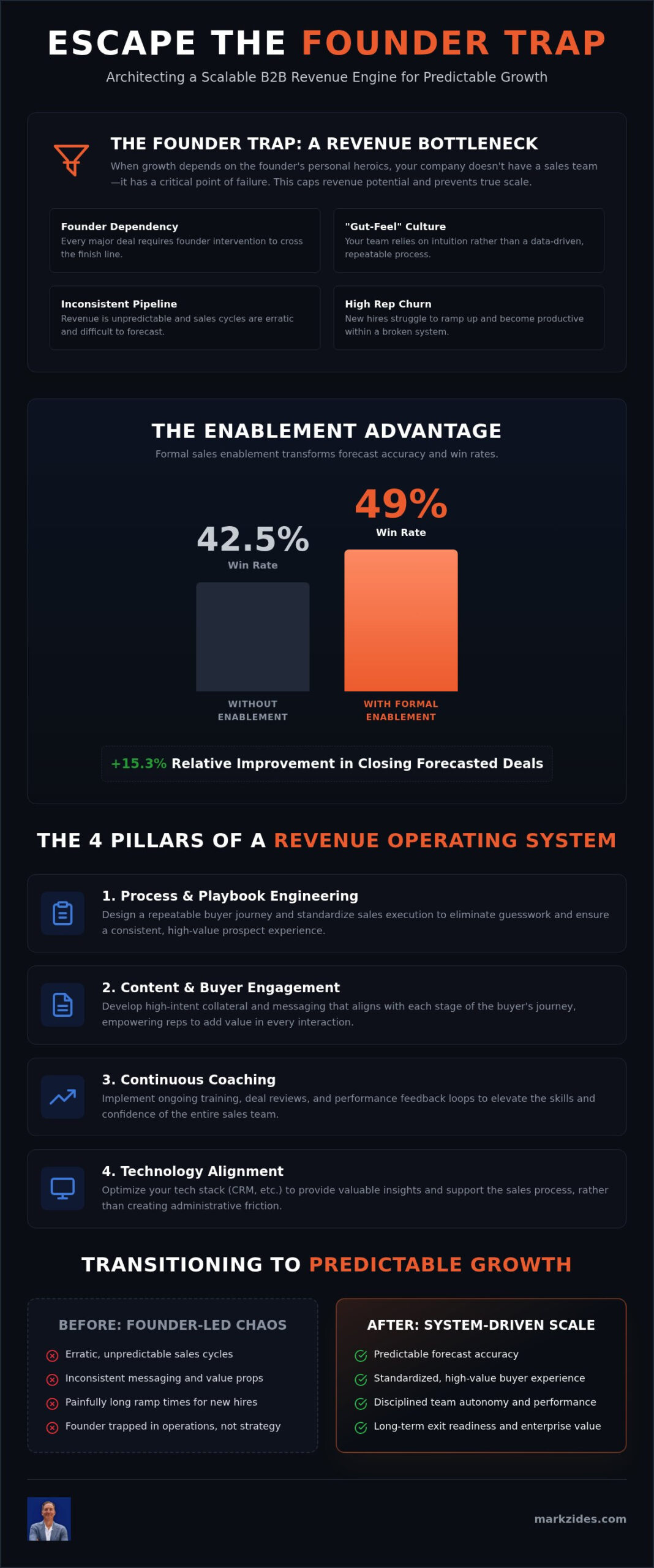
If your revenue growth still depends on the founder's personal involvement in every closing call, you don't have a sales team; you have a bottleneck. It's a common ceiling for high-growth firms where ambitious targets collide with messy CRM data and a lack of structured playbooks. Scaling past this point requires more than just hiring more reps. You must embed B2B sales enablement services that transform your "gut-feel" sales process into a high-precision revenue operating system. Organizations with formal enablement achieve a 49% win rate on forecasted deals, compared to just 42.5% for those operating without a structured framework.
You likely feel the weight of an inconsistent pipeline and a sales team that requires constant hand-holding to navigate complex deals. This guide provides the strategic blueprint to break that cycle. You'll discover how to transition from founder-led selling to a scalable revenue engine by aligning your tech stack, content, and coaching. We'll explore the specific frameworks used to build repeatable playbooks and predictable forecast accuracy for 2026. It's time to stop guessing and start architecting a sales team that performs with professional excellence and disciplined autonomy.
Key Takeaways
- Identify the symptoms of the "Founder Trap" and learn why a gut-feel sales culture creates a permanent revenue bottleneck for high-growth firms.
- Explore the four essential pillars of high-impact B2B sales enablement services, focusing on engineered buyer journeys and high-intent content strategy.
- Evaluate the ROI of Fractional CRO leadership versus agency models to determine the most efficient delivery system for your organizational maturity.
- Utilize a rigorous executive checklist to audit potential partners based on their operational experience and ability to embed repeatable systems.
- Discover the methodology for transitioning from erratic sales cycles to predictable forecast accuracy and long-term exit readiness.
The Founder Trap: Why Your B2B Sales Enablement Strategy is Stalling
Most B2B founders are the best salespeople in their company. While that's a point of pride in the early days, it quickly becomes a structural risk as you attempt to scale toward 2026. If every major deal requires your personal intervention to cross the finish line, you haven't built a sales team; you've built a support group for your own heroics. This "Founder Trap" is characterized by a "gut-feel" sales culture where reps mimic your passion but lack your process. They rely on intuition rather than data. They guess their way through discovery calls. Without professional B2B sales enablement services, your revenue growth will always be capped by your own calendar.
The common reflex is to hire more reps to solve the problem. However, adding headcount to a broken system only accelerates your burn rate. Without a repeatable blueprint, new hires struggle to find their footing, leading to high churn and inconsistent performance. Strategic enablement isn't about giving your team a few new slide decks or a login to a CRM. It's about moving from tactical support to a disciplined revenue engine. It's the difference between "hoping" your team closes and "knowing" they will because the system is designed for it.
The Cost of Inaction: Revenue Leakage and Burnout
Revenue leakage occurs when your sales process is so opaque that you can't identify why deals are stalling in the mid-funnel. Inconsistent messaging and a lack of high-intent collateral mean your reps are constantly reinventing the wheel for every prospect. This lack of structure leads to agonizingly long ramp times for new hires. If it takes six months for a rep to become productive, you're losing half a year of salary and opportunity cost per head. For the founder, the psychological toll is immense. You're trapped in the trenches, unable to focus on fundraising or exit readiness because the "magic" only happens when you're in the room.
Enablement as the Bridge to Scale
To scale in 2026, you must implement what we call a "Revenue Operating System." This isn't a vague concept; it's a hard-coded set of processes, tools, and content that empowers every seller to perform like your top 1%. A foundational Sales Enablement Definition focuses on providing the right resources to improve sales execution. However, modern B2B sales enablement services go further by aligning marketing, sales, and customer success under a single strategic vision.
For this to work, enablement cannot be a sub-function of HR or a side project for Marketing. It must report directly to the CRO or a fractional leader who understands the mechanics of a high-growth environment. This reporting structure ensures that every enablement initiative is tied directly to revenue outcomes rather than just "completion rates" on a training module. By embedding fractional leadership, you gain the executive-level oversight needed to build this bridge without the $400,000 price tag of a full-time hire.
The 4 Pillars of High-Impact B2B Sales Enablement Services
Building a high-velocity revenue engine requires more than just hiring talented sellers. It requires a structural framework that ensures every rep can replicate the success of your top performers. High-impact B2B sales enablement services focus on four critical pillars: process optimization, content strategy, continuous coaching, and technology alignment. When these elements are synchronized, they transform a chaotic sales floor into a disciplined, predictable system. If you're ready to stop guessing, building a scalable revenue engine starts with these foundational pillars.
Process and Playbook Engineering
Scaling revenue is impossible without a standardized methodology. You must design a repeatable buyer journey that removes friction at every touchpoint. This starts with the creation of a comprehensive Sales Playbook. A Sales Playbook is a living operational document that dictates real-time sales execution, rather than a static PDF gathering digital dust. By standardizing discovery calls and objection handling, you ensure that every prospect receives a consistent, high-value experience. This level of discipline allows you to identify exactly where deals are stalling and apply precise remedies to get them back on track. To ensure your architecture captures every stage of the buyer journey, a rigorous sales funnel optimization checklist can help you audit and eliminate the leakage points that cost you momentum.
Content and Buyer Engagement
The 2026 B2B buyer is more autonomous than ever. Research indicates that buyers often spend only a small fraction of their journey directly engaging with sales reps. Your content strategy must fill that gap. You need high-intent collateral, such as case studies and ROI calculators, that directly addresses the buyer's specific pain points. Understanding what is demand generation is vital here; your sales outreach must be an extension of your marketing narrative. By using this Authoritative Definition of Sales Enablement as a guide, you can align your messaging to ensure sellers provide value at every digital and physical interaction.
The Tech Stack Architecture
A cluttered tech stack is a productivity killer. Your technology must serve the process, not the other way around. This requires rigorous CRM hygiene and the use of data-driven insights to guide seller behavior. In 2026, leveraging AI for predictive lead scoring and automated outreach is no longer optional; it's a requirement for staying competitive. If your tools aren't talking to each other, you're losing money through data silos and manual entry errors. For a deeper dive into building a seamless system, consider sales tech stack consulting to architect a high-velocity revenue operating system that actually works. Organizations that successfully integrate these tools see a significant boost in win rates, often reaching 49% on forecasted deals compared to 42.5% for those without structured enablement.
Choosing Your Model: Fractional CRO vs. Agency vs. In-House
Deciding how to deploy B2B sales enablement services is a high-stakes architectural choice. You can build an internal department, hire an agency, or engage fractional leadership. Many firms default to "lead gen only" agencies, but this is a tactical error that often results in qualified leads dying in a broken funnel. These agencies focus on volume without the underlying sales system required to close complex deals. True scale requires aligning your enablement with exit readiness consulting goals from the start. You aren't just looking for leads; you're building a valuable, predictable asset.
The Fractional CRO Advantage
Executive leadership is expensive, but the cost of a strategic vacuum is higher. A full-time CRO can command up to $410,000 annually plus benefits. In contrast, a fractional CRO provides seasoned peer leadership for $10,000 to $20,000 per month. This model allows mid-market companies to embed B2B sales enablement best practices without the overhead of a full-time executive. These leaders bring a cross-industry perspective that prevents organizational tunnel vision. They don't just fix the sales floor; they drive a comprehensive partnerships and alliances strategy that accelerates growth through indirect channels.
Evaluating In-House Hires
Don't hire "doers" before you have a "designer." Most first-time enablement hires fail within 12 months because they're tasked with building a system they weren't trained to architect. They end up creating content that no one uses or managing tools that don't talk to each other. Strategic architecture must precede tactical hiring to ensure your team is executing a proven blueprint rather than improvising in a vacuum. By the time you realize you need a full in-house team, which can cost between $218,000 and $392,000 annually, you've often already missed your growth milestones. Using expert B2B sales enablement services to build the foundation first ensures that when you do hire internally, they're stepping into a high-performance machine rather than a construction site. The most effective way to achieve this is to build a repeatable sales process before expanding your headcount, so every new hire executes within a proven system from day one.
The Executive Checklist for Evaluating Enablement Providers
Buying B2B sales enablement services is a high-stakes investment in your company's infrastructure. It isn't a simple software purchase; it's a search for a strategic architect who can install a repeatable revenue engine. To separate battle-tested experts from surface-level consultants, you must look beyond slick presentations and assess their ability to build systems that function without constant founder intervention. If you want to stop winging it and start architecting a professional sales organization, audit your revenue systems with an expert operator today.
- Operational Experience: Have they actually scaled a mid-market firm to a successful exit?
- Methodology: Is there a documented, repeatable blueprint for discovery, qualification, and closing?
- Alignment: How do they bridge the gap between Sales, Marketing, and Success to create a single source of truth?
- Measurement: Do they commit to hard metrics like Sales Velocity, Ramp Time, and Win Rate?
The 'Operator' Test
Separating theorists from operators requires asking the right questions. You need to look for evidence of revenue systems that remained stable and productive after the founder stepped out of the sales process. A true partner views "exit readiness" as a primary service metric. They ensure that your sales organization is an asset with value independent of any single individual. If a provider cannot explain how they reduce your "key person risk," they aren't offering strategic enablement; they're offering temporary coaching that will evaporate the moment they leave.
The Tech and Tooling Audit
Most providers start with a tool recommendation. This is a red flag. High-impact B2B sales enablement services require a "Strategy First, Tools Second" mindset. Your provider should audit your existing CRM to identify data silos and messy workflows before suggesting new software. They must also demonstrate a deep understanding of change management and rep adoption. This is especially critical as Gartner predicts that by 2026, 30% of B2B sales cycles will be managed through digital sales rooms. Without disciplined adoption, the most advanced AI-driven tech stack is just an expensive, underutilized database.
Engineering Predictable Growth with Mark Zides
Scaling a revenue engine requires a shift from intuitive selling to industrial-grade precision. The Zides Methodology is designed to eliminate the "gut-feel" culture that stalls most mid-market firms. By implementing structured B2B sales enablement services, we replace founder-led heroics with a disciplined Revenue Operating System. This methodology ensures that your forecast accuracy isn't a guess; it's a data-driven projection based on repeatable seller behaviors and engineered buyer journeys.
Our 90-day roadmap transforms your sales organization into a high-velocity asset. During the first 30 days, we architect the strategic foundation and audit your existing tech stack. By day 60, we embed the core playbooks and integrate outsourced lead generation to ensure your pipeline is fueled by high-intent prospects. The final 30 days focus on rep adoption and optimization. This structured approach ensures your B2B sales enablement services provide a measurable return on investment before the first quarter concludes.
Strategic Revenue Alignment
Valuation is the ultimate metric of a successful revenue system. If you're preparing for fundraising or an acquisition, investors will scrutinize the sustainability of your growth. We align your GTM strategy with these long-term valuation goals by building a culture of radical accountability. This isn't about micro-management. It's about creating a legacy system that outlasts any single leader. If you are looking to protect and grow your enterprise value, check out 41 Legacy. When your sales execution is hard-coded into the organization, your company becomes significantly more attractive to buyers who value stability and predictable performance.
Your Path to the Next Level
The transition from a founder-led bottleneck to a scalable engine begins with an objective assessment. A fractional CRO engagement starts with a rigorous audit of your current sales execution, identifying the leakage points that are costing you momentum. We don't just provide a report; we embed ourselves as partners to fix the systems and coach your team toward professional excellence. If you're a high-growth founder ready to reclaim your time and scale your impact, book a strategic revenue audit to begin architecting your next level of growth.
Architecting Your Revenue Future
Transitioning from a founder-led "gut-feel" culture to a scalable revenue engine is the most critical move you'll make for your firm's long-term valuation. We've established that high-impact B2B sales enablement services aren't just about software; they're about engineering a repeatable system that removes bottlenecks and empowers every rep to perform like a top-tier operator. By focusing on process optimization and technology alignment, you replace individual heroics with a disciplined Revenue Operating System that delivers predictable results.
You don't have to navigate this transition alone. Whether you're optimizing for high-growth SaaS or preparing for a high-stakes acquisition, the right architecture is essential. Mark Zides provides the fractional CRO leadership and battle-tested Sales Playbooks needed to accelerate your momentum and ensure exit readiness. Scale Your Revenue Engine: Book a Strategic Audit with Mark Zides today and start building a high-performance organization that thrives with or without your direct intervention. Your path to predictable growth and professional excellence is just one strategic audit away.
Frequently Asked Questions
What is the difference between sales training and B2B sales enablement services?
Sales training focuses on individual skills while B2B sales enablement services focus on the organizational infrastructure. Training teaches a rep how to sell; enablement provides the playbook, the data, and the content to do it consistently. It's the difference between teaching a pilot to fly and building the entire air traffic control system. Enablement ensures that training doesn't evaporate after the workshop ends.
How long does it take to see ROI from sales enablement consulting?
You should expect to see measurable operational shifts within the first 90 days of an engagement. While top-line revenue growth usually follows the duration of your standard sales cycle, leading indicators like reduced rep ramp time and increased pipeline velocity appear much sooner. The goal is to install a system that compounds value over time rather than providing a temporary boost.
Do we need a specific CRM like Salesforce to benefit from enablement services?
Enablement is about the strategy and process rather than a specific software vendor. Whether you use Salesforce, HubSpot, or a niche CRM, the priority is data integrity and workflow alignment. We focus on optimizing your existing environment to ensure it serves the revenue team instead of creating administrative friction. A tool is only as effective as the process it automates.
Can a fractional CRO help with founder-led sales transitions?
A fractional CRO is specifically designed to bridge the gap between founder-led selling and a scalable team. They audit the founder's intuitive process and translate it into a documented methodology. This removes the founder as the single point of failure and allows the sales team to execute with the same level of precision. It replaces personality-driven sales with a repeatable system.
What are the core KPIs for measuring sales enablement success in 2026?
Beyond win rates, the most critical KPIs for 2026 include sales velocity and quota attainment across the entire team. You should also track content engagement metrics to see which assets are actually moving deals forward. High-performing B2B sales enablement services aim to lift the "middle 60%" of your sales force to match the performance of your top producers.
How does sales enablement support fundraising and exit readiness?
Enablement creates the "proof of machine" that investors and buyers demand during due diligence. By documenting a repeatable sales process and demonstrating predictable growth, you significantly increase your company's valuation. It transforms the business from a risky, personality-dependent startup into a stable, scalable asset. This clarity reduces perceived risk during fundraising rounds or acquisition talks.
Is sales enablement only for large enterprises or can startups benefit too?
Startups often gain the most from enablement because it prevents technical and process debt from accumulating. While enterprises use it to fix broken systems, startups use it to build a repeatable sales process and high-performance culture from day one. Implementing these systems early ensures you don't have to rebuild your entire sales floor when you hit the mid-market. It's an investment in sustainable growth.
What is the cost of typical B2B sales enablement services?
The investment for these services typically depends on the complexity of your sales cycle and the level of executive leadership required. Most organizations choose between project-based playbook development or an ongoing fractional leadership retainer. The focus should stay on the lifetime value of the revenue engine being built. Building a predictable system is always more cost-effective than the alternative of inconsistent growth.
Ready to build a revenue engine that runs without you?
Mark works alongside founders as a player-coach — not a slide deck.
Book a 30-minute call