
Scaling a Business: A Strategic Growth Framework

Scaling a business isn't an act of addition; it's an act of architectural design that replaces founder intuition with repeatable revenue operating systems. You've likely reached the point where your personal involvement in every deal has become the primary bottleneck to growth. It's the stage where revenue plateaus feel permanent, sales team churn is high, and your forecast accuracy is based more on hope than hard data. You're working harder than ever, yet the operational freedom you started this journey for seems to be drifting further away.
We've designed this framework to help you transition from a founder-led hustle to a predictable, high-performance enterprise. You'll master the operational structures and revenue systems required to remove yourself from the daily grind without sacrificing momentum. By the end of this guide, you'll have the blueprint to drive sustainable growth, reclaim your time, and significantly increase your company's valuation for a future exit. We're moving beyond gut-feel management and embedding the discipline of a battle-tested operator into your organization's DNA.
Key Takeaways
- Understand why scaling a business requires decoupling revenue growth from headcount to achieve exponential rather than linear results.
- Learn to design a robust revenue operating system that replaces founder intuition with data-driven decision making and predictable sales execution.
- Shift from a founder-led hustle to a system-led strategy, empowering your team to drive high-stakes deals without your constant intervention.
- Identify stage-specific talent and partnership opportunities that accelerate growth while maintaining operational excellence.
- Align your scaling strategy with exit readiness by eliminating operational debt and building the structural integrity acquirers demand.
Scaling vs. Growing: Why the Distinction Matters for Your 2026 Strategy
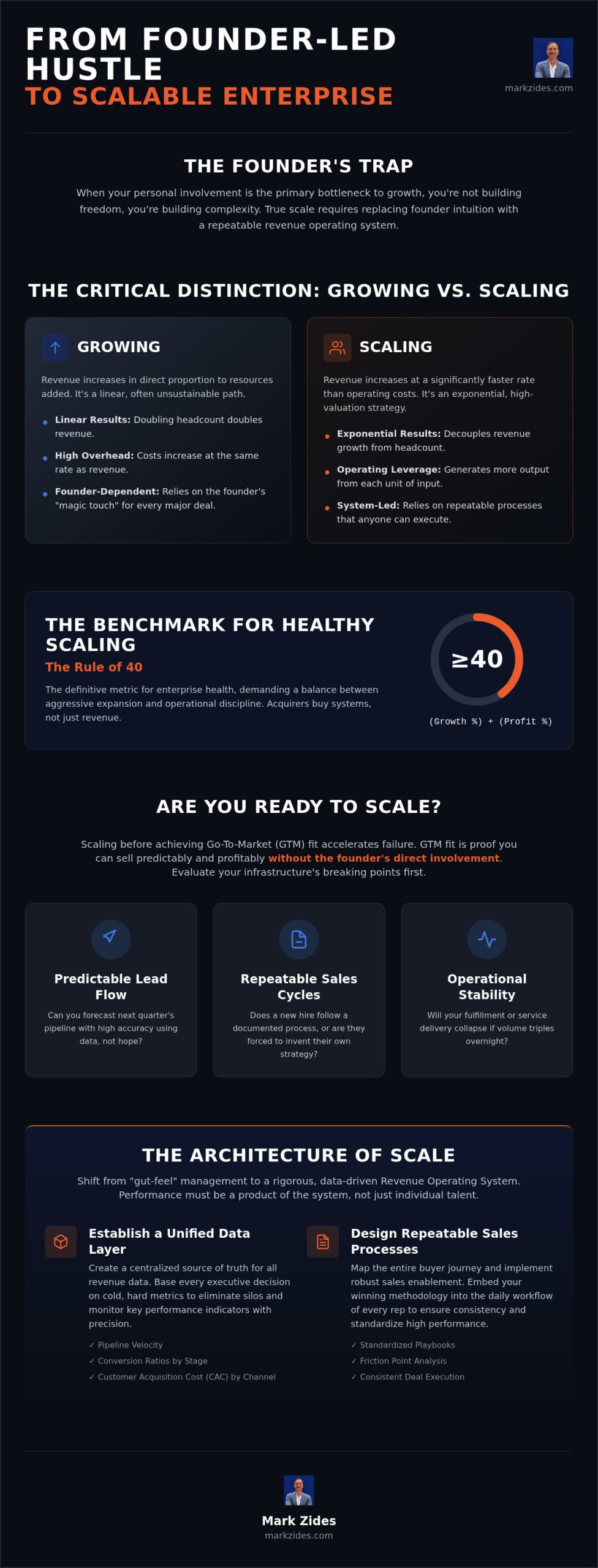
Growth is often a vanity metric. Scaling a business, however, is a strategic imperative. While growth represents a linear increase in revenue, scaling is the act of increasing revenue at a significantly faster rate than your operating costs. If your headcount must double every time your revenue doubles, you aren't scaling; you're simply getting bigger. This linear approach creates a fragile organization where margins remain thin and the founder remains the primary engine of every deal.
This dynamic often leads to the "Founder's Trap." In this scenario, growth doesn't bring freedom; it brings complexity that only the founder can manage. You become the ultimate bottleneck. True scaling requires operating leverage, which is the ability to generate more output from each unit of input. This leverage is what transforms a founder-led hustle into a high-valuation asset that attracts sophisticated acquirers. They don't buy your personal effort; they buy your systems.
The Mathematical Reality of Scaling
Scaling is a numbers game where the variables are Customer Acquisition Cost (CAC), Lifetime Value (LTV), and overhead. If your CAC is rising while your LTV remains stagnant, your scaling engine is leaking fuel. Hiring more sales reps to solve a revenue plateau often backfires because it adds immediate overhead without addressing the underlying systemic friction. This approach compresses your margins and slows your momentum.
By 2026, the "Rule of 40" has solidified as the definitive benchmark for healthy enterprise scaling. This metric requires that your combined growth rate and profit margin equal at least 40 percent. It demands a balance between aggressive expansion and operational discipline. If you can't hit this mark, your revenue operating system likely lacks the structural integrity needed for exponential growth. You can't hire your way out of a math problem.
Signs Your Business is Ready (or Not) to Scale
The most dangerous mistake an operator can make is scaling before achieving Go-To-Market (GTM) fit. Product-Market Fit proves people want what you sell; GTM fit proves you can sell it predictably and profitably without the founder's "magic touch." Before you accelerate, you must evaluate your infrastructure's breaking points. Consider these indicators:
- Predictable Lead Flow: Can you forecast next quarter's pipeline with high accuracy using data rather than hope?
- Repeatable Sales Cycles: Does a new hire follow a documented process, or are they forced to invent their own strategy?
- Operational Stability: Will your fulfillment or service delivery collapse if volume triples overnight?
Scaling a broken process doesn't fix it; it only accelerates failure. You must design the system before you fuel it. If your current operations require your constant intervention to prevent a collapse, you aren't ready to scale. You're ready to fix your foundation.
The Architecture of Scale: Building Your Revenue Operating System
Stop managing by intuition. Scaling a business requires an architectural shift from "gut-feel" decisions to a rigorous, data-driven revenue operating system. If your growth depends on the heroics of a few superstar sales reps, your foundation is unstable. A scalable enterprise demands a repeatable engine where performance is a product of the system, not individual talent. This transformation begins by establishing a centralized source of truth for your revenue data. Every executive decision must be based on cold, hard metrics rather than optimistic projections. A unified data layer allows you to monitor:
- Pipeline Velocity: How quickly prospects move from lead to closed-won.
- Conversion Ratios: The efficiency of your sales stages at every level.
- Customer Acquisition Cost (CAC) by Channel: The true ROI of your marketing spend.
When data flows seamlessly between departments, you eliminate the silos that trap revenue and stifle progress. You aren't just building a bigger company; you're designing a high-performance machine that operates with precision and clarity.
Designing Repeatable Sales Processes
A scalable sales engine is built on precision, not luck. You must map the entire buyer journey from the first touchpoint to long-term expansion, identifying every friction point that slows momentum. Implementing robust sales enablement is the only way to standardize performance across the team. It embeds your winning methodology into the daily workflow of every rep, ensuring that high-stakes deals are handled with consistent excellence. If the process is documented and the tech stack is aligned, then new hires can reach full productivity in weeks instead of months. Standardizing your tools reduces operational friction, allowing your team to focus on execution rather than troubleshooting broken workflows.
Marketing and Demand Gen Alignment
Revenue leakages often occur at the handoff between marketing and sales. To scale effectively, you must define Marketing Qualified Leads (MQLs) and Sales Qualified Leads (SQLs) with absolute clarity. Building a sustainable demand generation engine ensures that your pipeline remains full of high-intent prospects that match your ideal customer profile. It's not about lead volume; it's about lead quality and conversion velocity. This alignment prevents sales teams from wasting time on low-value activities. Fractional leadership often provides the strategic bridge necessary to align these departments, ensuring marketing spend is directly tied to sales capacity. If you're ready to stop the internal friction and start architecting a predictable growth path, exploring Fractional CRO services can provide the executive oversight your revenue systems require.
Decoupling Growth from the Founder: The Shift to System-Led Sales
Scaling a business demands a fundamental shift in the founder's identity. You must move from being the primary engine of revenue to becoming the architect of the systems that generate it. This transition is often the most difficult stage of growth. It requires the humility to accept that a well-designed system will eventually outperform your personal charisma. If your organization's success still hinges on your involvement in every high-stakes negotiation, you've created a bottleneck, not a legacy.
Transitioning from "Founder-Led Sales" to "Founder-Led Strategy" is the only path to a high-valuation exit. Acquirers don't pay for your personal talent; they pay for predictable, repeatable revenue streams that function independently of your daily presence. By scaling beyond founder-led sales, you effectively de-risk the investment and prove that your company is a sustainable asset. This shift allows you to focus on high-level vision while your revenue operating system handles the tactical execution.
The Fractional CRO Advantage
Mid-market firms often find themselves in a "no-man's land" where they need executive-level revenue leadership but can't justify the overhead of a full-time C-suite executive. This is where fractional CRO services provide a decisive advantage when scaling a business. A fractional operator brings the discipline of a seasoned veteran to your team, implementing a "90-Day Revenue Operating System" that aligns marketing, sales, and customer success. They don't just advise; they embed the frameworks necessary for your team to execute with precision. It's a strategic injection of expertise that accelerates your path to operational freedom without the full-time C-suite price tag.
Empowering the Next Layer of Leadership
To decouple yourself from the daily grind, you must transform your sales leaders from managers into coaches. This requires a move away from micromanagement and toward high-level accountability. Executive coaching serves as a vital tool during this transition, helping founders navigate the psychological shift of "letting go" while training their leadership team to think like owners. You must establish KPIs that drive performance without your constant oversight. Trust is built through structure, not through "checking in" on every deal. Focus on outcome-based metrics such as:
- Rep Ramp Time: The duration required for new hires to reach full productivity without founder intervention.
- Quota Distribution: The percentage of the sales team meeting targets independently.
- Pipeline Velocity: The speed at which deals move through the system-led sales stages.
When your leaders are empowered to solve problems using your established frameworks, the business begins to scale on its own momentum. You are no longer the hero of the story; you are the one who built the stage.
The Talent Strategy: Scaling Your Team and Capabilities
Scaling a business is not a simple matter of increasing headcount; it is a deliberate effort to increase talent density. You need stage-specific operators who have successfully navigated the exact revenue hurdles you're currently facing. A veteran executive from a legacy corporation often lacks the architectural mindset required to build systems from scratch in a high-growth environment. You aren't just looking for a resume. You're looking for a blueprint. This requires a culture of radical transparency where data, not ego, dictates every promotion and performance review.
High-growth organizations must also look beyond internal hires to fuel their momentum. Indirect revenue scaling, achieved through strategic alliances and outsourced tactical functions, allows you to maintain a lean core team while maximizing market reach. If your internal team is struggling to maintain pipeline velocity, leveraging Outsourced Lead Generation provides the tactical fuel needed to bridge the gap while you build your permanent roster. This approach ensures your sales team stays focused on high-value closing activities rather than getting bogged down in top-of-funnel friction.
Step 1: Audit Your Current Talent Gaps
Before you hire, you must identify the "Single Points of Failure" within your current structure. These are often legacy employees or even the founder themselves, whose absence would cause a total operational collapse. You must determine which functions are core to your competitive advantage and which can be handled more efficiently by external specialists. Talent density is the ratio of high-performers to total headcount. If that ratio is low, adding more people will only increase your operational debt and slow your decision-making speed. Focus on upgrading the quality of your "seats" before you increase the number of them.
Step 2: Implement a Strategic Partnerships Framework
You cannot reach every corner of the market alone. A sophisticated partnerships and alliances strategy acts as a force multiplier for your sales engine. By leveraging hyperscalers and industry-adjacent partners, you gain access to established trust and pre-vetted lead flow. This isn't about simple referrals; it's about engineering a co-selling environment where both parties have a clear path to ROI. If you align your incentives correctly, then your partners become an extension of your own sales force, accelerating your indirect revenue and increasing your overall company valuation. This systemic approach to talent and alliances ensures that your growth is both rapid and sustainable.
Exit Readiness: Scaling with the End in Mind
Every architectural decision you make while scaling a business should serve as a brick in the foundation of your eventual exit. If you build for growth but ignore the exit, then you're likely accumulating operational debt that will discount your valuation when it's time to sell. Sophisticated buyers look for companies that function without the founder. They seek predictable revenue engines, not personality-driven hustles. You're building an asset, and assets are defined by their ability to generate value independently of their creator.
Engaging in exit readiness consulting early in the scaling process allows you to identify these structural weaknesses before they become deal-breakers. It's about cleaning up the messy middle of your operations and ensuring that every system is documented, repeatable, and transparent. If you wait until you're in the letter of intent stage to fix your data, you've already lost your leverage. Preparation is the only cure for due diligence anxiety.
Optimizing the P&L for Acquisition
Acquirers are ruthless about revenue quality. You must identify and eliminate unscalable revenue streams that require excessive manual intervention or bespoke fulfillment. By 2026, valuation multiples are heavily skewed toward high-margin recurring revenue and sticky customer relationships. If your financial and operational data isn't due-diligence ready, then the deal will stall. You need a clean room of data that demonstrates:
- Customer Retention: Cohort-based analysis that proves long-term loyalty.
- Net Revenue Retention (NRR): Evidence that your existing customers are expanding their spend.
- Unit Economics: Proof that your Customer Acquisition Cost (CAC) is sustainable as you accelerate.
The Final Polish: Fundraising and Exit Preparation
Your narrative must evolve as you move toward a capital raise or exit. You're no longer pitching a small business; you're presenting a scalable platform. This shift in positioning is what separates a standard sale from a premium exit. Fractional leadership provides immediate credibility to VCs and PE firms. It signals that your organization has embedded executive-level discipline and isn't solely reliant on founder intuition. When you have a battle-tested CRO or operator in your corner, you demonstrate that the transition period post-acquisition will be seamless. You aren't just selling a company. You're selling a future-proof revenue machine that's ready for the next level of performance.
Architecting Your Path to Sustainable Growth
Scaling a business is a deliberate transition from founder-led hustle to a predictable, system-driven enterprise. True leverage comes from decoupling revenue growth from headcount and embedding a repeatable revenue operating system that functions without your constant intervention. By prioritizing exit readiness today, you ensure that your organization is building terminal value that commands respect in the marketplace. You aren't just growing a company; you're designing a high-valuation asset.
This journey requires the discipline of an expert operator who has been in the trenches. If you're ready to implement a battle-tested 90-Day Revenue Operating System and leverage fractional CRO expertise to optimize your valuation, the next step is clear. Mark Zides specializes in helping mid-market firms navigate these high-stakes transitions with precision and strategic alignment. Ready to scale your revenue operations? Schedule a strategy session with Mark Zides today.
The path from operational chaos to systemic clarity is structured and achievable. It's time to build the scalable enterprise your vision deserves and reclaim the freedom that inspired your journey. You've built the foundation; now it's time to architect the future.
Frequently Asked Questions
What is the difference between scaling and growing a business?
Scaling is the act of increasing revenue at a significantly faster rate than costs, whereas growth typically refers to a linear increase where expenses rise in tandem with income. When scaling a business, you focus on creating operating leverage. This allows your organization to handle a higher volume of transactions without a proportional increase in headcount. It's the difference between adding more weight to a cart and building a motorized engine.
When is the right time to start scaling my company?
You're ready to scale when you've achieved Go-To-Market fit rather than just product-market fit. This means your sales process is repeatable and your customer acquisition costs are predictable. If your revenue still depends on the founder's personal charisma or manual "heroics" to close deals, you aren't ready. Scaling a business at this stage only amplifies existing inefficiencies and accelerates a potential operational collapse.
How do I scale a business without losing its core culture?
Preserving culture during rapid expansion requires embedding your core values into the operational systems themselves. You must move from "culture by osmosis" to "culture by design" by establishing radical transparency and clear accountability frameworks. High-performance teams thrive when the rules of engagement are documented and fair. If you hire for stage-specific talent that aligns with your mission, the culture will strengthen rather than dilute.
Can a business scale without external funding or VC capital?
External capital is a fuel, not a requirement, for scaling. Many enterprises scale successfully by focusing on high-margin recurring revenue and aggressive operational efficiency. By maximizing your operating leverage and reinvesting profits into repeatable systems, you can maintain full control of your equity. Bootstrap scaling often leads to a more disciplined organization because every dollar spent must be tied to a clear, measurable outcome.
What are the most common mistakes founders make when scaling?
The most frequent error is scaling a broken process, which only leads to faster failure. Founders also often fail by remaining the primary bottleneck in the sales cycle for too long. Hiring for "big company" experience instead of stage-specific agility is another common pitfall. These mistakes create significant operational debt that eventually stalls momentum and complicates your future fundraising or exit efforts.
How does a Fractional CRO help in the scaling process?
A Fractional CRO acts as the strategic architect of your revenue engine, providing executive-level discipline without the full-time C-suite cost. They align marketing, sales, and customer success into a unified 90-Day Revenue Operating System. By removing the burden of sales execution from the founder, they enable the transition to a system-led organization. This ensures that growth is driven by data-driven frameworks rather than individual intuition.
How do I prepare my business for an exit while I am still scaling?
You prepare for an exit by viewing every operational decision through the lens of a potential acquirer. This involves cleaning up operational debt and ensuring your financial data is "due diligence" ready at all times. Focus on increasing your Net Revenue Retention and building a business that operates independently of your daily presence. A company that's easy to buy is one that has already mastered its internal systems.
Is founder-led sales a permanent bottleneck to scaling?
Founder-led sales is a necessary starting point but a permanent barrier to exponential scaling. If the founder is the only person who can close high-stakes deals, the business is a practice, not a scalable platform. You must decouple growth from your personal involvement by implementing sales enablement and standardized playbooks. True scale only begins when the system, not the individual, becomes the primary driver of new revenue.
Ready to build a revenue engine that runs without you?
Mark works alongside founders as a player-coach — not a slide deck.
Book a 30-minute call