
Building a Sales Engine from Scratch: The 2026 Executive Blueprint

A "hero" salesperson won't save your company, and a lucky quarter isn't a strategy. Most executives realize too late that their revenue growth is tethered to individual brilliance rather than organizational discipline. If you're building a sales engine from scratch in 2026, you aren't just hiring a team; you're architecting a repeatable revenue operating system. It's time to stop relying on the gut feel of a founder-led process and start embedding a machine that produces predictable results regardless of who is pulling the levers.
You likely know the frustration of a dry pipeline or the high cost of a failed sales hire. It's a cycle that drains capital and stalls momentum. This blueprint promises to transition your organization from unpredictable cycles to a scalable, data-driven operation. We'll explore the essential frameworks for strategic alignment, the role of fractional leadership, and the precise methodology for turning market interest into a reliable forecast. You'll gain a technical roadmap to drive sustainable growth without being trapped in every deal.
Key Takeaways
- Identify the operational bottlenecks of founder-led selling and learn how to institutionalize tribal knowledge into a repeatable framework.
- Master the three-pillar methodology for building a sales engine from scratch that prioritizes system scalability and data integrity over individual "hero" performance.
- Evaluate the strategic trade-offs between internal hires, fractional leadership, and outsourced lead generation to bridge pipeline gaps without incurring unnecessary management debt.
- Implement a disciplined 90-day execution roadmap to validate your ideal customer profile, deploy a high-performance tech stack, and align your revenue operations.
- Discover why investors pay a premium for systems-driven companies and how to future-proof your organization for maximum valuation during an exit.
The Founder Trap: Why Your Current Sales Approach Is Stalling
Founders are often the most effective closers in the early days of a company. They possess the vision, the passion, and the technical depth required to convince early adopters. However, this individual brilliance eventually becomes a liability. When every deal requires the founder's presence to cross the finish line, growth hits a hard ceiling. This is the exhaustion of founder-led sales. It manifests as unpredictable revenue cycles and a constant state of "gut-feel" anxiety that prevents long-term planning.
Building a sales engine from scratch requires dismantling the "hero culture" that many startups celebrate. Relying on a single superstar salesperson to carry the quota is a high-risk strategy. If that person leaves, your revenue goes with them. Real scale happens when you stop looking for unicorns and start designing a process that enables average performers to achieve exceptional results. Intuition-based selling might get you to your first $1M, but it will rarely carry you past $5M without breaking the organization.
The Limits of Unstructured Growth
Investors and VCs look for predictability. They view "gut-feel" forecasting as a significant red flag because it indicates a lack of control over the revenue stream. If you can't explain exactly how a lead becomes a customer through a repeatable series of steps, your business isn't yet an investable asset. The hidden cost of non-repeatable processes is the massive management debt you accrue every time you try to hire. Without a system, new hires take months to ramp. Many fail entirely because they lack a blueprint to follow.
The Founder Trap is a structural bottleneck where revenue growth is limited by the founder's personal bandwidth, technical expertise, and individual capacity to manage every high-stakes deal.
Moving Toward System-Led Execution
You must shift your mindset from being the "Closer-in-Chief" to becoming a "Systems Architect." A salesperson is simply a component of the machine; the sales engine is the machine itself. This engine consists of your data, your playbooks, and your technology stack working in unison. Establishing a "Revenue Operating System" means that your sales activities are no longer reactive. Instead, they are part of a deliberate, measured sequence designed to produce a specific outcome.
Transitioning to this model requires a disciplined approach to Scaling Beyond Founder-Led Sales: The 2026 Strategic Blueprint. When you focus on building a sales engine from scratch, you're creating an asset that increases the valuation of your company. You are proving that revenue is a product of design, not luck. This shift allows you to move from working in the business to working on the business.
The Architecture of a Modern Sales Engine: Systems Over Superstars
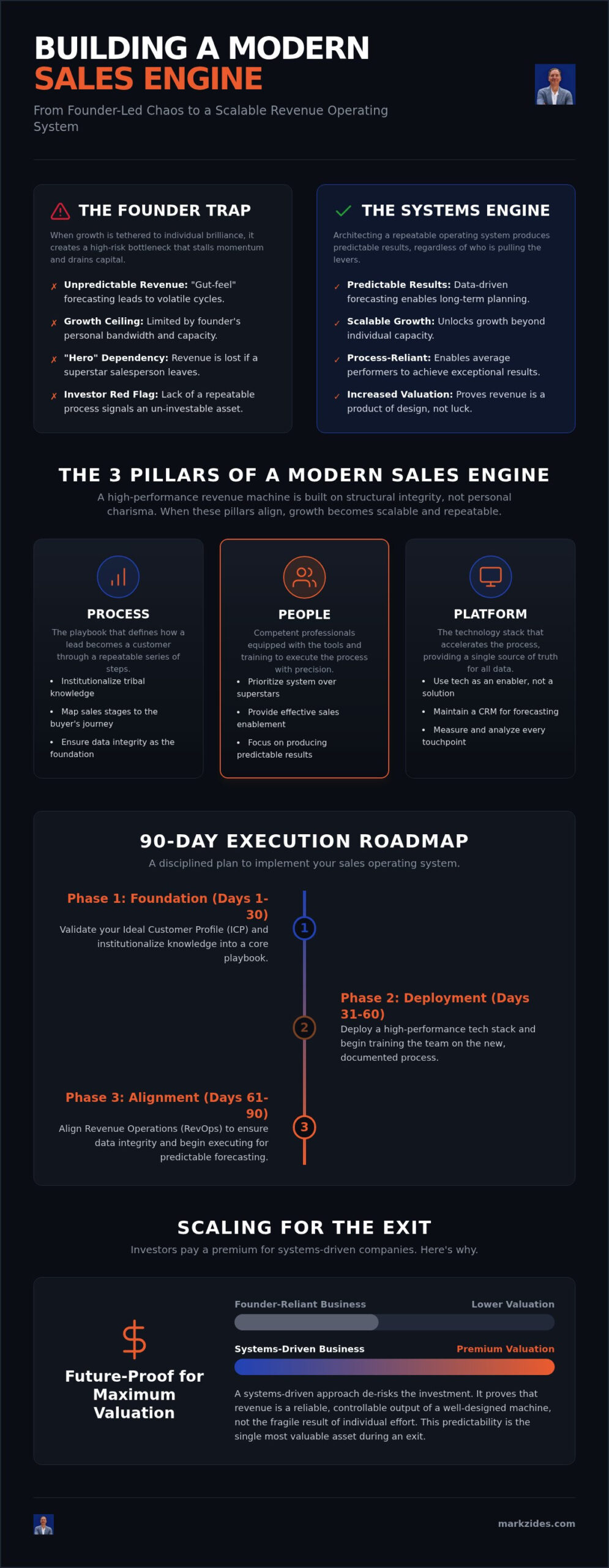
Stop looking for a "magic" hire to solve your revenue problems. Individual talent is a variable you cannot control at scale. A high-performance revenue machine is built on structural integrity rather than personal charisma. When you're building a sales engine from scratch, you must design a three-pillar framework: Process, People, and Platform. If these three pillars aren't aligned, your growth will remain erratic and expensive. The goal is to create a system where a competent professional can step in and produce predictable results by following your blueprint.
Revenue Operations (RevOps) serves as the engine's foundation. Data integrity is the oil that keeps the system from seizing. If your CRM is a graveyard of unlogged calls and outdated contact info, your forecasting will never be accurate. You need a single source of truth where every buyer touchpoint is recorded, measured, and analyzed. This visibility allows you to identify exactly where prospects are dropping out of the funnel, enabling you to fix the process rather than blaming the people.
Effective sales enablement means equipping your team to execute this blueprint with precision. It's not enough to tell them to "sell harder." You must map your internal sales stages to the actual buyer's journey. If your team is pushing for a demo while the prospect is still in the education phase, you'll lose the deal. A well-architected engine ensures that the right content and the right conversation happen at the right time.
The Tech Stack as an Enabler, Not a Solution
Your tools should accelerate your process, not define it. In 2026, a CRM must do more than store contacts; it must support predictive forecasting and pipeline health analytics. Utilize intent data to identify who is currently in-market and AI coaching tools to refine representative performance in real-time. If you're struggling to select the right infrastructure, fractional CRO services can provide the strategic leadership needed to architect your stack without the cost of a full-time executive.
Defining Your Ideal Customer Profile (ICP)
A "fuzzy" ICP is the primary cause of sales engine failure. If you attempt to sell to everyone, you'll scale nothing. You must develop a tiered target list for strategic outreach. Tier 1 accounts require high-touch, personalized engagement, while Tier 3 accounts are managed through automated demand generation. Aligning your outreach efforts with a clearly defined ICP ensures your team spends their most valuable asset, time, on the accounts with the highest probability of closing.
Strategic Resource Allocation: In-House, Outsourced, or Fractional?
Capital allocation is the ultimate test of a founder's strategic maturity. When building a sales engine from scratch, the instinct is often to hire a full team immediately. This is a mistake. The true cost of an in-house Sales Development Representative (SDR) in 2026 averages $11,000 per month during the first year when accounting for salary, benefits, tech stack, and management overhead. Beyond the cash burn, you must factor in "management debt." This is the time you lose training and supervising entry-level staff instead of closing high-value deals or refining your product-market fit.
A hybrid model often provides the highest ROI for mid-stage builds. By pairing internal Account Executives (AEs) with outsourced lead generation, you maintain control over the closing process while offloading the high-volume, repetitive tasks of prospecting. This structure ensures your most expensive internal resources are focused on conversion rather than discovery. It creates a lean, agile organization that can scale up or down based on market feedback without the friction of traditional hiring cycles.
Evaluating the ROI of Fractional Leadership
Most builders don't need a full-time VP of Sales early on; they need an architect. A Fractional CRO provides the high-level strategic leadership required to design your systems without the long-term C-suite price tag. They embed the processes and accountability frameworks that allow your engine to run autonomously. This approach allows you to match leadership seniority to your current revenue stage. You gain access to seasoned expertise to fix structural issues without committing to a permanent executive salary before the engine is fully built.
The Case for Outsourced Lead Generation
Outsourcing is your tactical bridge. It allows you to test new market segments and maintain a consistent flow of qualified meetings while you are building a sales engine from scratch. If a specific segment doesn't convert, you pivot the outsourced team instantly. This flexibility reduces your burn rate and prevents the demoralizing "hiring and firing" cycle of underperforming SDRs. It ensures your pipeline remains full during internal transitions, providing the stability needed to make data-driven decisions rather than desperate ones.
The 90-Day Roadmap to Implementing Your Sales Operating System
Building a sales engine from scratch is a project of precision, not just persistence. Success in revenue generation isn't about effort; it's about sequence. Building a sales engine from scratch requires a disciplined, phased approach to prevent operational chaos and wasted capital. You cannot scale a broken process, so the first 90 days must focus on establishing a foundation that is both repeatable and measurable.
- Days 1-30: The Audit and Alignment Phase. This period is dedicated to process mapping and ICP validation. You must verify that your target market actually feels the pain you solve. If your messaging doesn't resonate now, no amount of automation will fix it later.
- Days 31-60: The Infrastructure Phase. Here, you deploy your tech stack and finalize your sales enablement content. This includes CRM configuration, intent data integration, and the creation of outreach sequences that reflect the buyer's journey.
- Days 61-90: The Execution and Optimization Phase. Launch your outbound efforts and begin tracking North Star metrics. Monitor your Customer Acquisition Cost (CAC), Lifetime Value (LTV), and Pipeline Velocity to identify bottlenecks in real-time.
Establishing the Cadence of Accountability
A system without oversight is merely a suggestion. You need a rigorous schedule of weekly pipeline reviews to manage daily activities and monthly strategic pivots to address market shifts. Implementing a sales enablement program that sticks requires continuous reinforcement and data-backed feedback. The Cadence of Accountability is the engine's heartbeat, ensuring that daily actions remain synchronized with high-level strategic objectives.
Aligning Marketing and Sales
Silos are the enemy of scale. You must create a unified strategy that bridges the gap between lead generation and closing. This starts with understanding What is Demand Generation? The Executive Guide to Predictable Revenue. By ensuring consistent feedback loops between departments, marketing can refine lead quality based on real-world sales conversations. This alignment prevents the friction that usually occurs when sales teams complain about "bad leads" while marketing celebrates "high volume."
If you lack the internal bandwidth to manage this transition, Fractional CRO Services can provide the seasoned leadership needed to architect and oversee this 90-day implementation.
Scaling for the Exit: Future-Proofing for Maximum Valuation
Investors do not pay a premium for individual brilliance; they pay for the certainty of repeatable systems. When you are building a sales engine from scratch, your ultimate objective is to remove yourself from the revenue equation entirely. If the business cannot sustain its growth without your personal involvement in every high-stakes deal, you haven't built a company. You have built a high-paying job. Acquisition multiples are highest for organizations that demonstrate "transferability," meaning the revenue machine continues to produce results regardless of who is in the corner office.
Preparing your sales data for due diligence requires clinical discipline. Buyers will scrutinize your pipeline velocity, customer acquisition costs, and churn rates to find hidden risks. If your data is messy or inconsistent, it signals a lack of operational control and devalues your hard work. You must position your sales engine as a turnkey asset. It should be a plug-and-play machine that a buyer can fuel with capital to produce immediate, predictable returns. This level of institutionalized knowledge is what transforms a startup into a high-value acquisition target.
Leveraging Partnerships for Exponential Growth
Direct sales should only be one component of your broader revenue strategy. Building a hyperscaler partnership strategy allows you to augment your internal efforts and reach market segments that would otherwise be too expensive to acquire. This approach is detailed in Engineering Growth: The 2026 Partnerships and Alliances Strategy Blueprint. Creating these indirect revenue streams doesn't just increase your top line. It builds market defensibility that makes your company significantly more attractive to strategic acquirers.
Exit Readiness and Revenue Optimization
Clean up your revenue model long before you enter the data room. You must eliminate "dirty" revenue deals that don't fit your ICP or require excessive custom work to show a clear, scalable path forward. Utilize The 2026 Exit Readiness Checklist: Maximising Your Company Valuation to ensure your operational mechanics are aligned with investor expectations. By the time you reach a capital raise or an exit, your sales engine should be so well-documented and data-driven that its future performance feels like an inevitability rather than a gamble.
Architecting Your Path to Predictable Scale
Transitioning from the "Closer-in-Chief" to a strategic architect is the single most important pivot you'll make for your company's long-term valuation. Building a sales engine from scratch isn't about finding a "hero" hire; it's about embedding a repeatable revenue operating system that functions independently of your personal bandwidth. By following a disciplined 90-day roadmap and leveraging the right mix of fractional leadership and outsourced support, you replace "gut-feel" anxiety with the clarity of data-driven performance. You stop chasing deals and start managing a machine.
If you're ready to dismantle founder-led bottlenecks and future-proof your organization for a maximum-value exit, you need a battle-tested blueprint. Mark Zides offers the fractional CRO leadership and exit readiness expertise required to transform your sales department into a turnkey asset. Schedule a Strategic Consultation with Mark Zides to Build Your Revenue Engine and accelerate your transition toward predictable scale. Success is a product of design, and your journey to the next level begins with a single strategic decision.
Frequently Asked Questions
What is a sales engine exactly?
A sales engine is a repeatable, data-driven revenue operating system that converts market interest into predictable income without relying on individual heroics. It integrates three core pillars: Process, People, and Platform. Unlike a traditional sales team that depends on "gut-feel" and star performers, an engine uses documented playbooks and automated workflows to ensure that growth is a result of structural design rather than luck or founder-led brilliance.
How much does it cost to build a sales engine from scratch?
Total investment varies by scale, but you must budget for CRM infrastructure, lead data, and strategic leadership. In 2026, the all-in cost for a single in-house SDR often averages $11,000 per month during the first year. Building a sales engine from scratch also requires capital for sales enablement content and RevOps tools. Choosing fractional leadership or outsourced lead generation can significantly reduce these initial overhead costs while maintaining high execution standards.
How long does it take to see results from a new sales engine?
Most organizations observe initial pipeline movement within 30 to 60 days, with predictable revenue cycles typically emerging between 90 and 120 days. This timeline accounts for the necessary ramp period where your team validates the Ideal Customer Profile and refines outbound messaging. Speed to results depends heavily on the quality of your intent data and the discipline of your weekly accountability cadence. If your foundation is solid, momentum builds exponentially after the first quarter.
Can I build a sales engine without a full-time VP of Sales?
Yes, and many high-growth firms actually prefer starting with fractional CRO leadership to avoid the high fixed cost of a C-suite salary. You need the strategic architecture of a senior executive to design your systems, but you don't necessarily need them on the payroll 40 hours a week. Fractional experts provide the playbooks and accountability frameworks required to scale, allowing you to reinvest the saved capital into demand generation and sales talent.
What is the first hire I should make when building a sales team?
Your first hire should be a "Player-Coach" or a senior Account Executive who possesses the operational discipline to document the process as they sell. Hiring entry-level SDRs before you have a proven, repeatable playbook often leads to high turnover and wasted leads. You need an operator who can help build the engine's blueprints, not just a representative to operate a machine that doesn't yet exist. This hire bridge the gap between founder-led sales and a full department.
How do I know if my sales process is repeatable?
A process is repeatable when a new hire can achieve at least 80% of your top performer's results within their first full quarter. If your win rates, average deal size, and sales cycle lengths remain consistent across different team members, you have successfully moved past "hero-led" selling. Predictability in your monthly forecast is the ultimate indicator. When revenue becomes a product of your system's inputs rather than individual intuition, your engine is ready for scale.
What role does the founder play once the sales engine is built?
The founder transitions from being the primary closer to serving as the "Strategic Architect" and high-level visionary. You shift your focus toward architecting major partnerships, refining the product roadmap, and managing investor relations. Once the engine is operational, your involvement in deals should be by choice for strategic influence rather than by necessity to save the quarter. This transition is essential for increasing company valuation and ensuring the business can eventually sell without you.
Should I outsource lead generation or build it in-house first?
Outsourcing is often the most efficient way to validate your market and maintain momentum while building a sales engine from scratch. It allows you to generate qualified meetings immediately while you take the time to recruit, hire, and train an internal team. This hybrid approach reduces your initial burn rate and prevents the common mistake of building an expensive internal department on an unproven foundation. It provides the flexibility to pivot quickly based on real-world market feedback.
Ready to build a revenue engine that runs without you?
Mark works alongside founders as a player-coach — not a slide deck.
Book a 30-minute call