
Scaling Beyond Founder-Led Sales: The 2026 Strategic Blueprint

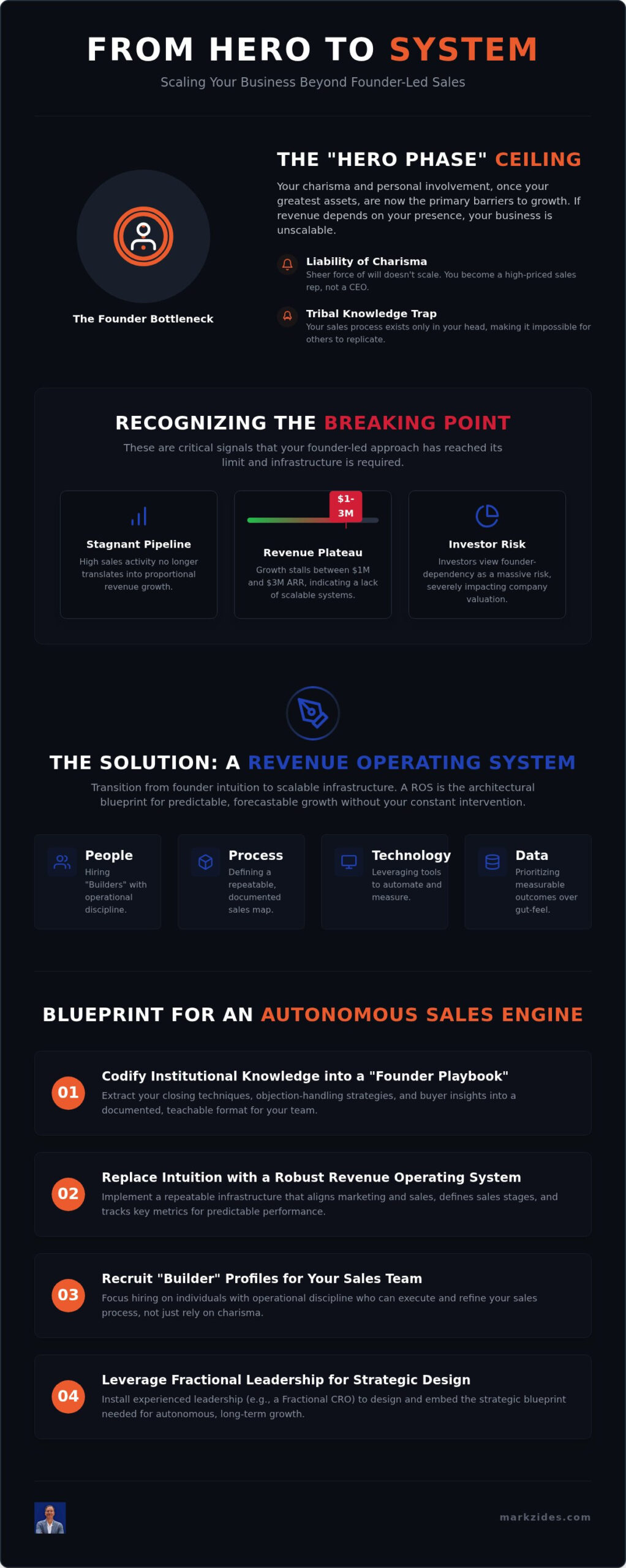
Your charisma is currently your company’s greatest liability. While your ability to close deals through sheer force of will secured your initial growth, it’s now the primary barrier to your next stage of evolution. If you remain the final word in every closing room, you aren't a CEO; you’re a high-priced sales rep. Scaling beyond founder-led sales requires a fundamental architectural shift from hero-based selling to a repeatable revenue operating system that functions without your constant intervention.
You’ve likely reached the point where you're the bottleneck for every major contract, leading to unpredictable revenue cycles and a deep-seated anxiety about the future. It's common to fear that delegating sales will burn your most valuable leads, but staying the course ensures your business remains a project rather than a scalable asset. This blueprint promises to show you how to build an autonomous sales engine that delivers predictable, forecastable results. We will detail the methodology for embedding sales enablement, aligning your revenue systems, and installing the strategic leadership required to focus on the high-level growth of your organization.
Key Takeaways
- Recognize the "Hero Phase" ceiling where your personal involvement in every deal becomes the primary barrier to hitting your next revenue milestone.
- Replace founder intuition with a robust Revenue Operating System (ROS) to ensure scaling beyond founder-led sales is driven by repeatable infrastructure rather than gut feel.
- Codify your institutional knowledge into a "Founder Playbook" that equips your team with the specific closing techniques and objection-handling strategies required for high-stakes execution.
- Focus your recruitment on "Builder" profiles who possess the operational discipline to refine your sales process while maintaining your brand’s high standards.
- Leverage fractional leadership to design and embed the strategic blueprint your organization needs to achieve autonomous, forecastable growth.
The Founder’s Dilemma: Why Founder-Led Sales Hits a Ceiling
The "Hero Phase" of your business was built on your personal charisma. In the beginning, your deep product knowledge and founder passion were your greatest assets. You closed deals because you were the visionary who could see the solution before it existed. However, this reliance on individual performance eventually creates a hard ceiling. Scaling beyond founder-led sales requires moving past this stage of intuitive brilliance and into a phase of operational discipline. If your revenue growth depends on your presence in the room, your business is inherently unscalable.
When your deal volume exceeds your available hours, you become the primary bottleneck. Every major contract waits on your desk; every negotiation requires your presence. This reliance on "Tribal Knowledge" means your sales process exists only in your head, making it impossible for a team to replicate your success. Without documented systems, you're essentially gambling with your leads. True growth requires transitioning from gut-feel execution to structured sales management principles that prioritize data over intuition. You aren't just hiring reps; you're installing a revenue operating system.
The Psychology of the Sales Exit
Stepping away from the front lines requires an identity shift from "The Closer" to the "Strategic Architect." You must design a machine that sells, rather than being the engine yourself. The Founder's Trap is the specific inflection point where the CEO's direct involvement in the sales cycle actually decreases deal velocity and prevents organizational growth. Many leaders hesitate here, fearing that a new hire will cause brand damage by failing to represent the company with the same level of care. Partnering with a brand strategist montreal can mitigate this risk by clarifying your positioning and messaging for a wider team. This fear is a signal that your process is not yet a system. If your brand depends entirely on your personal touch, you haven't built a business; you've built a job.
Recognising the Breaking Point in 2026
Identifying the threshold for change is critical for long-term survival. In the current high-stakes market, a stagnant pipeline despite high activity is a clear indicator that your manual approach has reached its limit. If your revenue plateaus between $1M and $3M ARR, your lack of infrastructure is the likely culprit. Beyond the daily stress, this bottleneck severely impacts your company valuation. Investors view founder-dependency as a massive risk factor. They want to buy a revenue engine, not a person. Transitioning through this phase often requires CEO coaching for revenue growth to help you navigate the shift from tactical operator to strategic leader. When you remove yourself from the room, you finally give your revenue the room it needs to grow.
Building the Revenue Operating System: From Intuition to Infrastructure
Stop relying on your intuition to hit your quarterly targets. While your gut feeling served you well in the early days, it cannot be taught, measured, or scaled. To achieve sustainable growth, you must replace personal brilliance with a Revenue Operating System (ROS). This framework serves as the structural foundation of your business, integrating People, Process, Technology, and Data into a single, cohesive unit. Successfully transferring founder knowledge to a sales team requires more than a few ride-along calls; it demands a system where every action is documented and every outcome is predictable.
A functional ROS eliminates silos between sales and marketing, ensuring both teams are aligned on the same revenue objectives. If your marketing team generates leads that your sales team cannot close, your system is broken. A Fractional CRO acts as the strategic architect of this alignment, designing the high-level roadmap and embedding the necessary rigor without the financial burden of a full-time executive. If you're ready to stop being the engine and start being the operator, exploring Fractional CRO Services can provide the clarity you need to move forward.
Defining Your Repeatable Sales Process
Your sales process must be a map, not a mystery. You need to document the buyer’s journey from the initial touchpoint to the final signature, identifying specific "Stage Gates" that a prospect must pass through to advance. These gates ensure that your pipeline remains clean and your forecasts stay accurate. By working with a business coach for entrepreneurs, you can refine these operational milestones to ensure they reflect the reality of your market. When your process is repeatable, your results become forecastable.
Technology as the Truth: CRM and Sales Stack
Spreadsheets are where data goes to die. In 2026, your CRM must be the "Single Source of Truth" for your entire organization. A modern sales stack leverages automation to handle repetitive tasks, allowing your reps to focus on high-value activities. Data hygiene is not a suggestion; it's a requirement for scaling beyond founder-led sales. If your data is messy, your decisions will be flawed. Implement tools that provide real-time visibility into your funnel, allowing you to identify bottlenecks before they become crises. Precision in your technology leads to precision in your revenue.
Sales Enablement: Equipping the Team to Sell Like a Founder
Sales enablement is the tactical bridge between your strategic vision and raw execution. It goes far beyond basic product training; it is the process of equipping your team with the specific tools, content, and intelligence required to navigate high-stakes negotiations. When scaling beyond founder-led sales, you cannot expect new hires to possess your innate passion or decade of context. You must provide it to them. If you fail to institutionalize your sales approach, your reps will revert to generic pitches that fail to resonate with executive buyers.
To maintain a healthy pipeline during this transition, you need a repeatable demand generation engine. Your sales team should focus on closing, not hunting for basic contact data. Utilizing Outsourced Lead Generation provides a critical buffer, allowing your internal team to focus on mastering the sales cycle while a steady stream of qualified prospects fills the calendar. This ensures that the momentum of your growth doesn't stall while your new hires are in the ramp-up phase.
The Playbook: Codifying Your Secret Sauce
Your "Founder Playbook" is the blueprint of your success. It must extract your institutional knowledge into repeatable scripts, discovery questions, and objection handlers. This document serves as the single source of truth for how your company wins. A playbook must be a living document updated quarterly based on real-world market feedback and evolving competitor tactics. By embedding case studies and verified proof points directly into the workflow, you empower your reps to build trust quickly without needing you in the room.
Building Rapport at Scale
New hires often struggle to establish the same executive presence that a founder naturally commands. You must teach them how to move beyond transactional conversations toward strategic connection. Mastering the art of building rapport is essential for reps who need to influence C-suite decision-makers. Sales execution consulting further refines this performance by providing objective feedback on rep-led calls, ensuring that the high standards you set during the "Hero Phase" are maintained across the entire organization. When your team can mirror your strategic depth, scaling beyond founder-led sales becomes a reality rather than a risk.
Hiring and Leading the First Non-Founder Sales Team
Hiring the right talent is the most significant operational risk in scaling beyond founder-led sales. Your first move is to identify the "Builder" profile. You don't need a polished "Scaler" who excels in a mature environment; you need a rep who thrives in ambiguity and possesses the discipline to help you refine the process. Next, implement a structured interview process focused on coachability and operational discipline. Conduct mock discovery calls to see how candidates handle feedback in real-time. If they can't follow a process during the interview, they won't follow your Revenue Operating System (ROS) once they're on the payroll.
Success in the first 90 days isn't measured by revenue. Your onboarding plan should prioritize system mastery over closing. If a rep can't navigate your tech stack or articulate your value proposition according to the playbook, they shouldn't be in front of a prospect. KPIs provide the clarity. You must track activity-based metrics to ensure the engine is humming:
- Discovery calls completed versus scheduled.
- Playbook adoption and CRM data hygiene.
- Pipeline generation within target accounts.
Finally, transition the founder to a "Mentor" role. As the team grows, your role must evolve. Stepping back from the primary closer role is a psychological hurdle that requires intentionality. Leadership is an architecture. Utilizing executive coaching for sales leaders provides the framework for this shift, ensuring you remain a strategic asset without becoming an operational bottleneck.
Managing the Transition: From Doing to Leading
Effective leadership in a post-founder-led environment centers on the sales 1-on-1. These sessions must move beyond "deal status" updates and focus on pipeline health and skill development. You're balancing autonomy with accountability. Give your reps the space to own their territory, but hold them to the rigorous standards of your documented process. Systems drive the performance. When you stop managing deals and start managing the system, you empower your team to operate without your constant intervention.
The Compensation Model for Scalability
Your incentive structure dictates rep behavior. Design plans that align with long-term revenue goals rather than short-term wins to avoid "commission breath." Ensure reps focus on quality over volume by tying a portion of their bonus to data accuracy and the documentation of new sales insights. If you're ready to build a team that operates with executive-level precision, apply for executive coaching to master the architecture of a scalable sales organization.
Institutionalising Growth: The Role of Fractional Leadership
Hiring a full-time Chief Revenue Officer too early is a common executive misstep that drains capital without delivering immediate ROI. At the $1M to $3M ARR mark, you don't need a $300,000 executive to manage a small team; you need a strategic architect to build the foundation. A Fractional CRO provides the high-level roadmap and operational rigor required for scaling beyond founder-led sales without the prohibitive overhead of a permanent C-suite hire. This model allows you to inject decades of revenue expertise into your organization exactly when you need it most, ensuring your growth is built on a professional framework rather than luck. To explore how professional consultancy can support your transition to a repeatable growth model, visit Strategy & Execution Advisors.
Preparing your organization for fundraising or exit readiness requires more than just high revenue numbers. Acquirers look for systemized revenue cycles that demonstrate sustainability and predictability. If your sales process is still locked in your head, your company's valuation will suffer. By institutionalizing your sales execution now, you're building a business that is a scalable asset rather than just a high-paying job for the founder. Exploring fractional CRO services provides the strategic blueprint needed to navigate this transition with precision.
The Bridge to a Permanent Revenue Leader
Fractional leadership serves as the essential bridge to your eventual full-time revenue leader. Instead of hiring a VP of Sales into a chaotic environment, you use a Fractional CRO to design and install the Revenue Operating System first. This ensures your future hire inherits a high-functioning machine rather than a mess they are forced to fix. The Fractional CRO's primary goal is obsolescence through successful systemisation. They hire and train your initial team, codify the playbook, and establish the KPIs so that the permanent leader can focus entirely on accelerating an already successful engine.
Maximising Valuation Through Scalable Sales
Scalability is the ultimate currency of business valuation in 2026. Investors pay a premium for organizations that demonstrate they don't rely on the founder’s personal network or individual sales talent to grow. When your revenue stream is forecastable and detached from your personal involvement, you've achieved true operational excellence. Integrating exit readiness consulting into your long-term plan ensures that every sales hire and process improvement directly increases your company's multiple. Transitioning from a founder-led model to a system-led model is the final step in creating a business that is a valuable, liquid asset.
Architecting Your Exit from the Sales Floor
The transition from founder-led growth to a repeatable revenue engine is the most critical architectural shift your organization will ever make. Success demands that you move beyond individual charisma and embed a structured Revenue Operating System that prioritizes data over intuition. Codifying your vision into a living playbook and equipping your team with high-stakes enablement tools transforms your business from a high-paying job into a truly scalable asset. Scaling beyond founder-led sales isn't just about hiring reps; it's about installing the systems that allow those reps to thrive without your constant presence in the room.
Building this infrastructure requires a specialist who understands the mechanics of revenue alignment and valuation maximization. Mark Zides is an expert in fractional CRO leadership and revenue architecture, specializing in the sales execution and enablement required for exit readiness. Whether you're focused on rapid growth or preparing for a future exit, the right system ensures your success is forecastable and sustainable. Scale your revenue operations with Mark Zides' Fractional CRO Services today. Your business is ready to grow. It's time to give it the system it deserves.
Frequently Asked Questions
What is the first hire I should make to move away from founder-led sales?
Hire a "Builder" account executive who thrives in early-stage ambiguity. This individual shouldn't just be a closer; they must be capable of helping you document and refine the initial playbook. While a "Scaler" needs a finished system to succeed, a Builder helps you construct the system while generating revenue. This hire is the first step in scaling beyond founder-led sales by proving that a non-founder can successfully navigate the sales cycle.
How do I know if my sales process is actually repeatable?
Your process is repeatable when a new hire achieves consistent win rates using only your documented playbook and tech stack. If a rep requires your presence to close mid-market deals or handle standard objections, your process is still intuitive rather than industrial. Consistency across different territories and reps is the ultimate proof of a systemized revenue engine. Once you see predictable stage-gate velocity without your intervention, you have a scalable asset.
When is the right time to hire a Fractional CRO vs. a full-time VP of Sales?
Hire a Fractional CRO when you need to architect a Revenue Operating System but aren't ready for the high overhead of a permanent executive. This usually occurs between $1M and $3M ARR. A VP of Sales is a tactical leader who manages people; a Fractional CRO is a strategic architect who builds the infrastructure those people need to succeed. If your systems are broken, a VP won't fix them; they'll just manage the chaos.
Can a salesperson really sell my vision as well as I can?
A salesperson can sell your vision more effectively than you can because they focus on the buyer's outcomes rather than the founder's passion. While you sell through charisma, a professional rep sells through a repeatable methodology. By codifying your secret sauce into a sales enablement framework, you empower them to establish executive presence. They don't need your intuition if they have a blueprint that addresses specific market pains and proof points.
What are the most important sales KPIs to track when scaling?
Prioritize activity-based metrics and pipeline velocity over lagging indicators like total revenue. Track the number of qualified discovery calls completed, the conversion rate between stage gates, and the average time spent in each funnel phase. These KPIs reveal exactly where the bottleneck exists in your system. High-growth organizations focus on lead-to-opportunity ratios because they provide the early warning signals needed to adjust strategy before the quarter ends.
How much does it cost to implement a Revenue Operating System?
Implementing a Revenue Operating System is primarily an investment in leadership and technology infrastructure. While expenses vary based on your existing tech stack and the complexity of your market, the true cost is found in the revenue lost to a stalled, founder-dependent pipeline. Investing in fractional leadership and sales enablement tools typically pays for itself by accelerating deal velocity and increasing the overall efficiency of your sales team as you scale.
What happens to my company valuation if I am still the main salesperson?
Your company valuation will likely face a significant founder-dependency discount if you remain the primary salesperson. Investors and acquirers look for a turnkey revenue engine that functions independently of the CEO. If you are the one closing every major contract, the business is viewed as a risk rather than a scalable asset. Systemizing your sales execution increases your multiple by proving the business can grow without your personal involvement.
Is outsourced lead generation better than hiring an internal SDR?
Outsourced lead generation is often superior during the initial transition because it provides an immediate, stable pipeline without the management overhead of an internal SDR. This allows your first sales hires to focus entirely on mastering the closing process and refining the playbook. Once your Revenue Operating System is mature and your closing rates are predictable, you can then consider bringing lead generation in-house to capture more granular market data.
Ready to build a revenue engine that runs without you?
Mark works alongside founders as a player-coach — not a slide deck.
Book a 30-minute call