
The Strategic Planning Process: A 2026 Blueprint for Revenue Scale

Most executive teams treat their annual retreat as a creative writing exercise rather than an engineering project. If your plan doesn't directly dictate your daily revenue operations, it's not a strategy; it's a hope. You're likely exhausted from the constant friction of stagnant growth despite your team's high-intensity effort. It's frustrating to lead when you're stuck firefighting instead of scaling, and the persistent misalignment between sales and marketing feels like an unsolvable puzzle. This guide provides the rigorous, operator-led framework you need to master the strategic planning process and transform abstract 2026 goals into a repeatable revenue engine.
You deserve a system that replaces gut-feel anxiety with the calm of structured, predictable results. We'll detail the architectural steps to align your teams, stabilize your forecasts, and build the enterprise value required for a premium exit. By the end of this blueprint, you'll have the clarity to stop reacting to the market and start architecting your company’s future valuation. We'll move from high-level vision to the granular execution required to scale with precision and confidence.
Key Takeaways
- Architect a scalable revenue operating system that converts market opportunities into predictable, high-margin growth.
- Master a five-step strategic planning process built on deep revenue diagnostics and the identification of core value drivers for 2026.
- Eliminate departmental friction by unifying sales, marketing, and operations into a single, high-velocity revenue engine.
- Operationalize your strategy through a disciplined performance cadence that ensures your plan lives in the field rather than on a shelf.
- Maximize company valuation by documenting systems that reduce key-person risk and prove your business is ready for a premium exit.
What is the Strategic Planning Process in a Revenue-First Organization?
Forget the dusty binder sitting on a shelf. In a revenue-first organization, the strategic planning process isn't an annual suggestion; it's a rigorous, data-driven methodology for resource allocation. It's the difference between a founder guessing at market trends and a Strategic Architect engineering a repeatable path to scale. If you're leading a high-growth company, your plan must be a living document that dictates daily operations and long-term valuation.
In 2026, the stakes for precision have never been higher. With the effective federal funds rate at 3.63% and new HSR thresholds impacting merger reporting at $133.9 million, market volatility is the only constant. A static plan is a liability. A dynamic strategic planning process allows you to pivot without losing momentum. The ultimate output is a "Revenue Operating System," a structured framework that functions independently of any single executive's intuition or "gut feel."
The Shift from Tactical Firefighting to Strategic Execution
Most founders are trapped by the "magnetic pull of today." They spend 90% of their energy solving immediate fires while tomorrow's challenges remain unaddressed and unbudgeted. A documented process breaks this cycle by forcing a shift from reactive to proactive leadership. It moves the burden of success from founder-led intuition to a system of collective accountability. When you define the methodology clearly, you provide:
- A blueprint for autonomous decision-making across the leadership team.
- Clear guardrails for resource allocation that prevent "shiny object syndrome."
- A direct link between individual performance and company-wide valuation goals.
Why Your Revenue Engine Fails Without a Process
Revenue isn't a happy accident. It's the result of precision alignment between sales, marketing, and operations. Without a unified process, these departments often work at cross-purposes, chasing different KPIs and wasting capital on "random acts of marketing" that don't convert into pipeline. You need data-driven decision making to validate every move in your 2026 forecast. If you aren't using hard data to steer the ship, you're just expensive passengers on a drifting vessel. A structured planning framework ensures that every dollar spent on demand generation or sales enablement is a deliberate step toward a fixed point of success.
The 5-Step Strategic Planning Framework for 2026
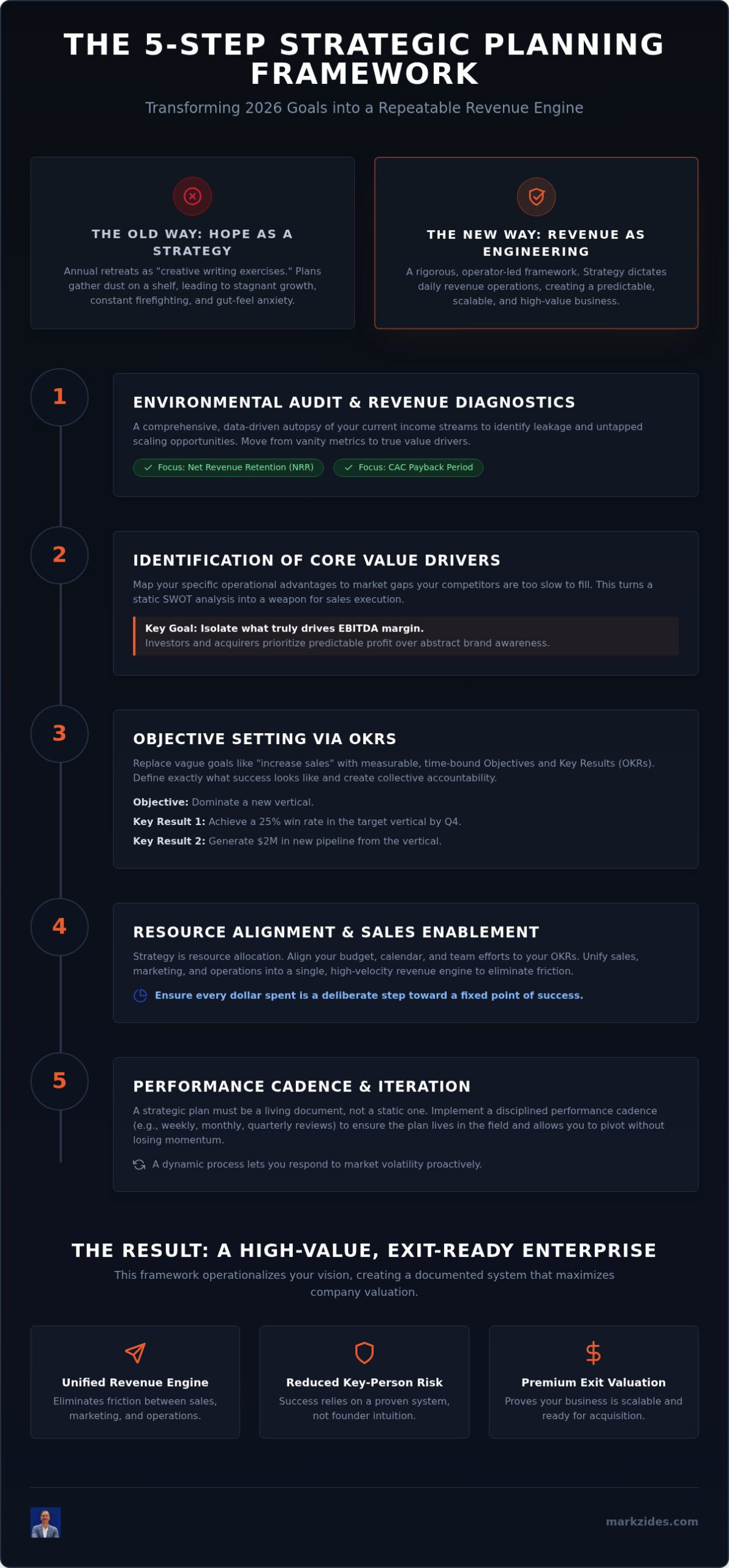
High-growth operators don't have time for 100-page slide decks that nobody reads. You need a lean, high-velocity strategic planning process that translates directly into revenue. This framework isn't a suggestion; it is the blueprint for building a business that is both scalable and exit-ready. Success in 2026 requires moving through five distinct phases with clinical precision:
- Phase 1: Environmental Audit & Revenue Diagnostics.
- Phase 2: Identification of Core Value Drivers.
- Phase 3: Objective Setting via OKRs (Objectives and Key Results).
- Phase 4: Resource Alignment & Sales Enablement.
- Phase 5: Performance Cadence & Iteration.
Phase 1 & 2: Audit and Value Driver Identification
A Revenue Diagnostic is a comprehensive, data-driven autopsy of your current income streams designed to identify leakage and untapped scaling opportunities. You must be ruthless here. Separate vanity metrics, such as website traffic or social engagement, from true value drivers like Net Revenue Retention (NRR) and Customer Acquisition Cost (CAC) payback periods. Investors and acquirers don't care about your "brand awareness" if it doesn't convert into a predictable EBITDA margin. When conducting a SWOT analysis, stop listing generic "strengths." Instead, map your specific operational advantages to market gaps your competitors are too slow to fill. This turns a static list into a weapon for sales execution.
Phase 3 & 4: OKRs and Resource Allocation
Vague goals are the enemy of accountability. Replace "increase sales" with measurable, time-bound OKRs that define exactly what success looks like by Q4 2026. If your objective is to dominate a new vertical, your key results must include specific pipeline targets and win rates. Strategy is ultimately about resource allocation. Show me your calendar and your bank statement, and I’ll tell you your strategy. If your primary goal is expansion but your budget is consumed by legacy maintenance, your plan is already failing. Ensuring sales enablement is baked into the planning phase prevents your strategy from dying in the CRM. You must equip your team with the specific tools and playbooks required to execute the vision you've designed.
Finally, Phase 5 focuses on Operationalizing the Plan through a disciplined performance cadence. A strategy that isn't reviewed weekly is just a dream. You need a rhythm of accountability to ensure the strategic planning process stays alive in the field. If you are struggling to bridge the gap between your 2026 vision and your team's daily output, engaging a fractional CRO can provide the external discipline needed to install these systems correctly.
Aligning Sales, Marketing, and Operations: The RevOps Advantage
Speed is often confused with progress in high-growth environments. Sales leaders frequently argue that a rigorous strategic planning process slows them down, distracting the team from hitting their monthly quotas. They're wrong. If your team is running at full tilt in the wrong direction, you're only accelerating your failure. True velocity comes from a unified Revenue Engine where sales, marketing, and operations function as a single, frictionless machine. This alignment, often referred to as "Smarketing," isn't a corporate buzzword; it's an operational requirement for 2026. A Fractional CRO acts as the architect of this integration, ensuring that every department is working toward the same revenue targets and valuation milestones.
In the B2B healthcare sector, SalesSparx provides the specialized go-to-market strategy and revenue execution expertise needed to architect these high-growth systems effectively.
Eliminating Silos Through a Shared Strategic Vision
Silos are where revenue goes to die. To scale effectively, you need a single source of truth for your revenue data. Marketing can't celebrate generating 1,000 MQLs if Sales reports that none of them are qualified for the pipeline. This disconnect is a symptom of a failed planning process. To fix it, you must align marketing’s demand generation activities directly with sales’ pipeline requirements. This requires shared KPIs across the entire executive leadership team. When everyone is measured by the same North Star metric-predictable revenue-the internal friction disappears. You're no longer just generating leads; you're engineering the entire customer journey to maximize lifetime value and acquisition readiness.
Strategic Planning as a Tool for Sales Enablement
Strategy shouldn't live in a boardroom; it must be felt in the field. A clear strategic planning process equips your sales reps to move beyond commodity-based selling and close higher-value, enterprise-level deals. When a rep understands the company's strategic position, they sell with more confidence and authority. This clarity is further amplified by a robust partnerships and alliances strategy. A well-engineered partnerships and alliances strategy functions as a force multiplier, converting indirect relationships into a high-velocity stream of qualified revenue. By baking these alliances into your core plan, you reduce the burden on direct sales and diversify your income streams against market volatility. Alignment isn't just about internal harmony. It's about building a scalable ecosystem that supports sustainable, high-margin growth while preparing the business for a premium valuation.
Operationalizing the Plan: Moving from Paper to Performance
A strategy that lives in a 50-page slide deck isn't a plan; it's an expensive piece of fiction. To scale revenue, you must convert your vision into a living system. This means moving beyond high-level concepts and embedding them into your team's daily rhythm. If your strategic planning process doesn't dictate your weekly meeting agenda, it hasn't been operationalized yet. You need a "Performance Cadence" that forces accountability at every level of the organization.
Real-time visibility is non-negotiable. Modern operators use CRM tools and integrated dashboards to track strategic progress in real-time. This allows you to see exactly how your tactical efforts are feeding your long-term objectives. Without this data, you're managing by "gut feel," which is a recipe for stagnation in a volatile 2026 market. You must bridge the gap between paper and performance through disciplined execution and constant monitoring of your core value drivers.
The Quarterly Business Review (QBR) as a Strategic Pivot
The QBR is your primary mechanism for adjustment. It is the moment where you evaluate your current progress against your OKRs and decide whether to stay the course or adjust your tactics. Differentiating between "pivoting" and "losing focus" is vital. A pivot is a calculated response to data; losing focus is a reactive jump toward a new trend. If your win rates are dropping or your sales cycle is lengthening, these are early warning signs that your plan needs an overhaul. Use the QBR to refine your approach without losing the momentum you've built.
Executive Accountability and the Role of Coaching
Founders are often the biggest bottleneck in their own growth. It's difficult to hold yourself accountable to a strategy when you're busy firefighting. This is why high-level Executive Coaching is a core component of successful execution. A coach provides the external discipline needed to maintain an "Operator Mindset," ensuring that you stay focused on the systems that drive long-term value. They help you bridge the gap between strategic intent and daily action, turning a static document into a dynamic revenue engine. Without this external perspective, even the most robust strategic planning process can stall under the weight of daily operational demands. If you're ready to stop firefighting and start leading with precision, explore how Executive Coaching can accelerate your results.
Strategy as the Foundation for Exit Readiness and Valuation
Acquirers don't buy past performance; they buy the certainty of future cash flow. A documented strategic planning process is the most effective tool for proving that certainty. When you can demonstrate that your revenue is the result of a repeatable system rather than heroics from the founder, your multiple increases. This process effectively reduces "Key Person Risk," transforming the business from a founder-led project into a turnkey asset.
Preparing for due diligence starts years before a Letter of Intent (LOI) arrives. By linking your 2026 objectives to long-term exit readiness consulting, you ensure that every operational decision increases your enterprise value. With the minimum HSR transaction threshold for 2026 set at $133.9 million, reaching the scale required for a major acquisition demands a level of precision that "gut feel" management can't provide. You're building a "Revenue Engine" that is auditable, transparent, and ready for the scrutiny of institutional buyers or private equity firms. An auditable engine includes:
- A documented history of forecast accuracy versus actual performance.
- Clearly defined customer acquisition channels with stable unit economics.
- A leadership team that operates independently of the founder's daily input.
Maximizing Valuation Through Process Documentation
Predictability is the highest-value asset in any M&A transaction. A strategic plan serves as a roadmap for the buyer’s future growth, showing them exactly where the next $10M or $50M in revenue will come from. Ensuring fundraising readiness is a core component of the plan. Whether you are seeking a Series B or a full exit, the rigor of your strategic planning process signals to investors that you are a disciplined operator who manages by design, not by luck. The global strategic planning software market is projected to reach $3.59 billion in 2026, reflecting a broader shift toward these data-driven execution platforms.
Building the Exit Blueprint
Start with the end in mind. Identifying potential acquirers during the strategic planning phase allows you to tailor your operations to their specific requirements. If you know a strategic buyer values high NRR or specific technological integrations, you can prioritize those value drivers in your 2026 roadmap. Aligning your current operations with the requirements of a 2028 exit ensures that you aren't just growing, but growing in a way that the market is willing to pay a premium for. This includes the brand’s visual maturity, where Zero Nine Design offers creative consulting and coaching to ensure your company’s identity matches its high-growth trajectory. You've built the engine; now you're just tuning it for the highest possible bidder.
Scale your revenue and prepare for your exit with Mark Zides.
Architecting Your 2026 Revenue Future
Scaling a high-growth organization requires more than just ambition; it demands a clinical approach to execution. You've seen how a rigorous strategic planning process serves as the foundation for a predictable revenue operating system. By aligning your sales, marketing, and operations under a single, data-driven framework, you eliminate the friction that causes stagnation. You're no longer just managing a company; you're engineering a high-value asset.
The transition from firefighting to strategic leadership is a choice. It's the decision to prioritize long-term valuation over short-term chaos. Whether you're scaling a SaaS platform or a B2B service provider, the goal remains the same: a business that's sustainable, repeatable, and ready for a premium exit. Precision in your methodology today dictates the multiple you'll command tomorrow.
Ready to move from gut-feel to forecast accuracy? Explore Mark Zides’ Fractional CRO and Strategic Consulting Services. We provide battle-tested revenue operating systems and specialized expertise in scaling SaaS and B2B organizations for maximum valuation. The blueprint is in your hands. It's time to build with confidence.
Frequently Asked Questions
What is the difference between a business plan and a strategic planning process?
A business plan is a static document typically used for initial funding or internal goal-setting. In contrast, the strategic planning process is a dynamic, repeatable operating system for resource allocation. While a plan describes what you intend to do, the process defines the methodology for how you'll pivot and scale. It's the difference between a map of the territory and the actual navigation system in the vehicle.
How often should a scaling company update its strategic plan?
Scaling companies should conduct a full strategic review annually, with rigorous quarterly pivots. In high-growth environments, a static three-year plan is obsolete within months. You need a performance cadence that includes weekly tactical reviews to ensure daily actions align with your 2026 revenue goals. This frequency prevents the "magnetic pull of today" from overriding your long-term valuation objectives and keeps the organization agile.
Who should be involved in the strategic planning process?
The process requires the executive leadership team (ELT) and key department heads from sales, marketing, and operations. You don't need every employee in the room, but you do need the "Strategic Architects" who own the P&L and the resources. Input from frontline managers is essential for reality-testing the plan, but final accountability rests with the leadership team to ensure total departmental alignment.
How long does a typical strategic planning cycle take to implement?
A typical strategic planning cycle takes four to eight weeks to design and 90 days to fully operationalize. The initial diagnostic and audit phases usually require 14 days of deep data analysis. Once the OKRs are set, the next 60 days focus on sales enablement and embedding the performance cadence into the CRM. Real stability in the revenue engine usually emerges by the end of the first quarter.
Can a fractional CRO lead the strategic planning process?
Yes, a fractional CRO is often the ideal architect for the strategic planning process because they provide external discipline without the bias of internal politics. They bring a battle-tested blueprint from other high-growth organizations to build your revenue operating system. Their role is to install the framework, align the teams, and ensure the business is prepared for a premium exit or fundraising round.
What are the most common reasons strategic plans fail to execute?
Most plans fail due to lack of accountability and the creation of "shelf-ware" decks. If the strategy isn't linked to the weekly meeting rhythm and the budget, it'll be ignored in favor of tactical firefighting. Other common failures include misaligned KPIs between sales and marketing or a lack of real-time visibility into performance data. Without a disciplined cadence, the plan dies under the weight of daily operations.
How do you measure the ROI of the strategic planning process?
Measure the ROI through forecast accuracy, EBITDA margin expansion, and the reduction of customer acquisition costs (CAC). A successful strategic planning process should also result in a higher enterprise valuation by reducing key-person risk. If your revenue becomes more predictable and your teams are more aligned, the return on investment is realized through the premium multiple you command during an exit or acquisition.
Ready to build a revenue engine that runs without you?
Mark works alongside founders as a player-coach — not a slide deck.
Book a 30-minute call