
Data-Driven Decision Making: The Executive Guide to Predictable Revenue and Scale

By 2026, Gartner predicts that 65% of organizations will make decisions that are fully data-driven. If you're still relying on founder intuition to steer your growth, you're not just falling behind; you're gambling with your company's valuation. Transitioning to a culture of data driven decision making is no longer a luxury for the enterprise elite. It's the baseline requirement for any executive who wants to replace high-stakes anxiety with operational certainty.
You've likely felt the sting of inconsistent sales forecasts or the frustration of marketing spend vanishing into unproven channels. It's exhausting to walk into a board meeting or a fundraising session without the hard evidence needed to defend your strategy. This guide shows you how to embed a structured operating system that transforms raw numbers into a repeatable revenue engine. You'll learn to move past the "gut-feel" era and build a business that's both predictable and attractive to future acquirers.
We'll detail the exact methodology for aligning your sales execution with real-time analytics and accelerating your path to a premium exit valuation.
Key Takeaways
- Transition from the "Gut-Feel Era" to a modern revenue operating system where strategic choices are anchored in analyzed facts rather than executive intuition.
- Align demand generation and sales execution by mapping precise data flow across the entire customer journey, from initial lead to final exit.
- Master data driven decision making to eliminate low-level operational uncertainty, freeing leadership to focus on high-level creative innovation and strategic pivots.
- Execute a 5-step roadmap to audit your current tech stack and establish "North Star" metrics like Revenue Velocity and Customer Acquisition Cost.
- Command higher multiples during fundraising or acquisition by replacing "founder hopes" with the rigorous, data-backed forecasts that VCs and private equity firms demand.
What is Data-Driven Decision Making (DDDM) in a Revenue Context?
In a high-growth environment, clarity is your most valuable asset. While many executives rely on their "nose for the business," true scale requires a shift from the Gut-Feel Era to the Operating System Era. Data driven decision making is the practice of anchoring every strategic revenue choice in analyzed facts instead of executive intuition. It's the process of building a business nervous system that tells you exactly where to invest, where to cut, and where to pivot with mathematical certainty. Organizations that embrace this approach report 5 to 6 percent higher productivity and profitability than their peers, according to verified industry research.
This shift is the core foundation of professional fractional CRO services. A Revenue Leader doesn't guess; they design systems that capture and interpret three critical pillars of data. First is Customer Data, which tracks behavior, lifetime value, and churn risk. Second is Market Data, identifying shifting demand and competitor moves. Third is Operational Data, measuring the efficiency of your internal sales and marketing machines. By integrating these pillars, you move toward a model of data-informed decision-making that secures your revenue and maximizes your eventual company valuation.
The Evolution from Intuition to Evidence
Early-stage growth often survives on founder gut-feel. You're close to the customer and the market moves fast. However, mid-stage scale introduces "Intuition Bias," where leaders remember the one big win but ignore the ten small losses that drained the budget. Relying on intuition during a scale-up leads to reactive firefighting. You're constantly solving the same problems because you don't have the evidence to fix the root cause. Transitioning to data driven decision making allows you to move from reactive defense to proactive strategic planning. It replaces the anxiety of the unknown with the calm of a structured, predictable system.
The Core Components of a Data-Driven Revenue Engine
Building this engine requires more than just a CRM. It starts with Data Collection, where you set up "Top of Funnel" telemetry to track every touchpoint. If you can't measure the lead's journey, you can't optimize it. Next is Data Analysis. This is where you turn raw metrics into actionable insights that tell a story. Finally, you must establish Data Governance. This ensures a single source of truth across sales and marketing. Without governance, your teams will argue over which numbers are correct instead of how to grow them. When these components align, you create a repeatable revenue engine that functions with precision and accountability.
The Architecture of a Data-Driven Revenue Operating System
Revenue is not a happy accident. It is the measurable output of a deliberate, architected system. To scale beyond the founder's reach, you must design a framework where data flows seamlessly from the first marketing touchpoint to the final contract signature. This architecture relies on data driven decision making to align every department under a single objective: predictable growth. When you treat your revenue process as an integrated operating system rather than a series of siloed activities, you gain the ability to spot friction before it stalls your momentum. Companies that successfully quantify these gains report an average 8 percent increase in revenue and a 10 percent reduction in costs, according to industry research.
Modern B2B environments require "Revenue Intelligence." This is the practice of capturing every interaction within the customer journey to create a lead-to-revenue (L2R) map. This map ensures that your efforts in what is demand generation are perfectly synchronized with your sales execution. If marketing is generating volume but sales isn't converting, the data tells you exactly where the disconnect lies. It removes the finger-pointing between teams by providing a shared, objective reality. If you want to see how this alignment looks in practice, you can explore fractional CRO strategies designed to embed these systems into your organization.
Mapping the Data Journey: Lead to Close
A data-driven architecture exposes the "leaky buckets" in your sales funnel. By analyzing conversion data at each stage, you can identify where prospects are dropping off and why. This level of granularity allows you to refine your ideal customer profile (ICP) based on who actually closes and stays, rather than who simply clicks. Furthermore, sales enablement data provides a blueprint for individual rep performance. It highlights the specific behaviors that lead to success, allowing you to replicate those actions across the entire team. You aren't just managing people; you're managing a high-performance system.
Predictive Analytics vs. Historical Reporting
Looking at last month's revenue is like driving while looking in the rearview mirror. It tells you where you've been, but not where you're going. By 2026, the competitive advantage will belong to those who use predictive analytics to anticipate market shifts. Predictive models allow you to identify churn risks before they happen and surface upsell opportunities with surgical precision. This forward-looking approach is also vital when building a partnerships and alliances strategy. Instead of guessing which partners might work, you use proven channel ROI data to invest in the relationships that actually drive the bottom line. This shift from historical to predictive is what separates static companies from those built for rapid, sustainable scale.
The Founder Dilemma: Balancing Intuition with Hard Data
Many founders view data driven decision making as a strategic straitjacket. They fear that rigid metrics will stifle the very creativity that sparked their initial success. This is a fundamental misunderstanding of operational excellence. In reality, a robust data system acts as a safety net. It removes the low-level uncertainty of daily operations, freeing you to focus on high-stakes visionary work. When you don't have to guess if your sales team is hitting their marks, you have the mental bandwidth to dream up the next category-defining product.
We utilize a "Hybrid Operator" framework to manage this transition. In this model, your gut is for the spark; it drives the zero-to-one innovation that defines a brand. Data is the fuel; it provides the one-to-n scale required to build a legacy. Transitioning between these two states is difficult. It requires a mental shift that many leaders struggle to make alone. This is where executive coaching becomes essential. It helps leaders decouple their professional identity from "always having the answer" and instead focuses them on building a system that provides the answer automatically.
When to Trust Your Gut (And When Not To)
Your intuition is a powerful tool for navigating uncharted territory. If you're launching a brand-new product or entering a nascent market, there may not be enough historical data to guide you. This is the time for bold, founder-led bets. However, once a process becomes repeatable, gut-feel becomes a liability. Scale requires the "Trust but Verify" model. You might have a "feeling" that a new marketing channel will work, but you must use data to verify that hypothesis within a 90-day window. This prevents "False Positives," where a single lucky win is mistaken for a scalable strategy.
Building Rapport and Buy-In for a Data Culture
Implementing a data-driven culture often meets internal resistance. Teams may feel that new tracking requirements are a form of micromanagement or a "gotcha" tool. To overcome this, you must frame data driven decision making as a tool for empowerment. When everyone looks at the same dashboard, expectations are clear and successes are undeniable. It removes the politics from performance reviews. As a leader, you must model this behavior by bringing data to every meeting. If the team sees you making pivots based on evidence rather than whim, they will begin to value the system over the person. This alignment is what transforms a group of individuals into a high-performance organization.
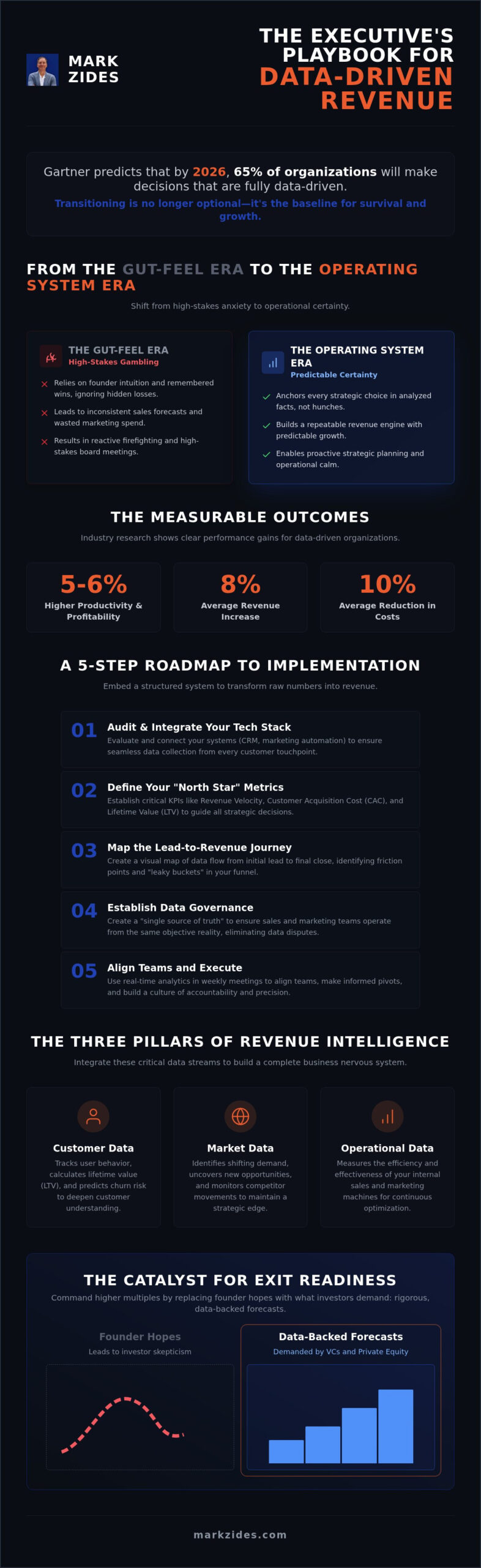
Implementing DDDM: A 5-Step Roadmap for Scaling Teams
Scaling a revenue engine is an engineering challenge. It requires a blueprint that moves beyond aspirational goals and into granular execution. To embed data driven decision making into your team's DNA, you must follow a methodical 5-step roadmap. This process ensures that your data isn't just collected, but utilized to drive predictable, high-margin growth. By 2026, the gap between organizations that measure performance and those that actively improve it will become an insurmountable chasm. This roadmap is your bridge across that divide.
Step 1 & 2: Setting the Foundation
You must define your objectives before you buy your software. Many executives make the mistake of purchasing a high-end CRM to "fix" a broken sales process. Software is merely an accelerant; it will only make your existing inefficiencies happen faster. A Fractional CRO begins by auditing your current revenue engine to identify data gaps. We focus on defining "North Star" metrics such as Revenue Velocity, Customer Lifetime Value (CLV), and Customer Acquisition Cost (CAC) first. Once these benchmarks are set, we align your tech stack to prioritize sales execution over simple data storage. Your tools must serve the operator, not the other way around.
Step 3 & 4: Operationalizing the Insights
Data is only as good as the hands that input it. To prevent the "Garbage In, Garbage Out" trap, you must establish rigorous data hygiene standards. This starts by training your sales team to view the CRM as a strategic asset rather than an administrative burden. When reps see how data helps them close larger deals faster, resistance fades. We then embed these insights into your weekly cadence. Your Quarterly Business Reviews (QBRs) and pipeline meetings should move away from anecdotal status updates. Instead, use visual dashboards to conduct at-a-glance health checks and drive data-driven strategy. If a deal is stalling, the data should tell you why before the rep even speaks.
Step 5 is the continuous loop of iteration. As your team scales, your metrics will evolve, and your systems must adapt to maintain peak efficiency. If you're ready to stop guessing and start growing, you can implement a 90-day revenue roadmap that builds this architecture for you.
Data-Driven Decision Making as a Catalyst for Exit Readiness
Valuation is a measure of risk as much as it is a measure of revenue. When you eventually sit across the table from a venture capital firm or a private equity buyer, they won't just look at your top-line growth. They'll scrutinize your "Data Maturity." Buyers are looking for proof that your success is the result of a repeatable system rather than a series of lucky breaks or founder-led heroics. Implementing data driven decision making is the ultimate de-risking strategy. It transforms your business from a black box into a transparent, predictable asset that commands a premium multiple.
Data-backed forecasts carry far more weight than "founder hopes" during the due diligence process. If you can show a direct correlation between marketing spend, lead velocity, and closed-won revenue over a multi-year period, you eliminate the perceived volatility of your income stream. This transparency builds immediate trust with investors. It demonstrates that you have a firm grip on the levers of your business and can accurately predict how future capital will accelerate growth. In the high-stakes environment of 2026, firms that cannot provide this level of granular evidence are often hit with "valuation haircuts" or see deals stall indefinitely. Completing a structured exit readiness consulting process ensures your data narrative is airtight before you ever enter a buyer conversation.
Maximizing Valuation Through Predictability
Predictability is the primary driver of EBITDA multiples. Consistent data reduces the perceived risk of a revenue stream, making it more valuable to a buyer. For instance, having granular churn data allows you to prove that your retention is stable and your customer lifetime value is growing. This is far more persuasive than a general statement about "happy customers." Additionally, you must use data to prove the scalability of your demand generation engine. If you can demonstrate that every dollar invested in a specific channel yields a predictable return, you've essentially provided the buyer with a blueprint for their own success. You're no longer selling a company; you're selling a high-performance machine.
Preparing for the Exit: The Data Clean-Up
You can't build an investor-grade narrative overnight. Most successful exits require 18 to 24 months of clean, consistent data to stand up to the rigors of due diligence. This includes ensuring your systems are compliant with the latest regulations, such as the data privacy laws that took effect in Kentucky, Rhode Island, and Indiana on January 1, 2026. Buyers will look for any reason to devalue your firm, and sloppy data governance or non-compliance is a major red flag. You must package your revenue data into a compelling story that highlights your operational excellence and market positioning. Our fundraising readiness consulting and fractional leadership services focus on this "finish line" preparation. We help you design the systems today that will secure your highest possible valuation tomorrow.
Secure Your Future Through Operational Excellence
Transitioning to a structured revenue system is about more than just hitting next quarter's targets. It's about building an asset that stands up to the scrutiny of the world's most rigorous investors. By embedding data driven decision making into your core operations, you replace the volatility of intuition with the stability of a repeatable, scalable engine. You've seen the architecture required to align demand generation with sales execution and the roadmap to de-risk your business for a high-multiple exit.
The journey from founder-led growth to institutional-grade scale requires battle-tested leadership. Mark Zides provides the fractional CRO expertise and executive coaching necessary to design, embed, and accelerate these systems within your organization. Whether you're preparing for a major fundraising round or a future acquisition, our proven methodology ensures your revenue is both predictable and defensible. If you're ready to move from gut-feel to forecast accuracy, schedule a consultation with Mark Zides today. Your next level of performance is not a matter of luck; it's a matter of design. Build the operating system that secures your legacy.
Frequently Asked Questions
What is the most important metric for data-driven decision making?
Revenue Velocity is the single most critical metric for any high-growth organization. It combines your pipeline volume, win rate, average deal size, and sales cycle length into a single indicator of health. By monitoring this number, you can pinpoint exactly which lever to pull to accelerate growth. If your velocity stalls, the data reveals whether the bottleneck is in lead generation or sales execution.
How do I start being data-driven if my current data is a mess?
You must perform a forensic audit of your current tech stack and isolate your core revenue drivers. Don't attempt to fix every data point at once. Focus on establishing a "single source of truth" for your North Star metrics first. Once you have clean telemetry for your primary sales funnel, you can gradually expand your data hygiene standards to secondary channels and marketing activities.
Does data-driven decision making replace executive intuition?
Data doesn't replace intuition; it validates it. Your gut-feel is essential for zero-to-one innovation and identifying brand-new market opportunities where historical data doesn't yet exist. However, data driven decision making provides the fuel for scale. It acts as a strategic filter that separates high-potential pivots from expensive distractions, ensuring your visionary energy is always backed by operational evidence.
How much does it cost to implement a data-driven revenue system?
The investment is determined by your current tech debt and the complexity of your organizational scale. Building a robust system involves software integration, data cleansing, and the leadership required to drive cultural change. While the initial setup requires capital, the long-term ROI comes from the elimination of marketing waste and the removal of inefficient sales processes that consistently drain your bottom line.
How does data-driven decision making affect company valuation?
Predictability is the highest-valued asset in any acquisition. Investors pay significantly higher multiples for companies that demonstrate a repeatable, data-backed revenue engine. By removing the risk associated with "founder-led heroics," you prove that the business can thrive under new ownership. This transparency directly increases your EBITDA multiple and secures a more favorable exit during the due diligence process.
What is the role of a Fractional CRO in data-driven decision making?
A Fractional CRO acts as the strategic architect who designs and embeds your revenue operating system. They bridge the gap between high-level ambition and granular execution. By implementing a 90-day roadmap, they move your organization from gut-feel to forecast accuracy. They ensure that your sales, marketing, and partnership teams are perfectly aligned under a shared, objective data framework that drives accountability.
Can small businesses benefit from data-driven decision making?
Small businesses have the least room for error, making data driven decision making a vital survival tool. When resources are limited, you can't afford to waste spend on unproven marketing channels. Even basic tracking of customer acquisition costs and conversion rates provides the clarity needed to make strategic pivots before your runway disappears. Operational discipline is always more important than the size of your budget.
Ready to build a revenue engine that runs without you?
Mark works alongside founders as a player-coach — not a slide deck.
Book a 30-minute call