
Marketing and Sales Alignment Consulting: The 2026 Executive Roadmap to Scalable Growth

If you are considering marketing and sales alignment consulting, it's likely because you recognize that misalignment costs companies over $1 trillion annually in lost productivity. Most executives feel this friction daily. You see the wasted marketing spend on leads that sales ignores, and you hear the constant complaints about lead quality. It's the "gut-feel" anxiety of founder-led sales hitting a ceiling because there's no single source of truth for your revenue data. You aren't alone; research shows that only about 8% of companies currently describe their alignment as strong.
Fixing this friction isn't about soft skills or better meetings. It's about installing a structured Revenue Operating System that replaces intuition with forecast accuracy. This article provides the 2026 executive roadmap to bridge the gap between departments using a battle-tested blueprint for scalable growth. We'll preview how to unify your GTM strategy, lower your Customer Acquisition Cost (CAC), and build a predictable path toward your next fundraising round or exit. It's time to stop guessing and start engineering a repeatable revenue engine that commands respect from investors and competitors alike.
Key Takeaways
- Transition from intuition-based growth to a structured Revenue Operating System that integrates people, processes, and platforms into a single architecture.
- Identify hidden friction points by conducting a rigorous GTM audit to determine exactly where leads are falling through the cracks during the handoff.
- Establish a unified "North Star" metric and a shared Ideal Customer Profile to eliminate cross-departmental finger-pointing and ensure strategic synchronization.
- Utilize marketing and sales alignment consulting to provide the executive authority and objective blueprints required to build a repeatable, scalable revenue engine.
- Maximize your valuation for future fundraising or exit by replacing unpredictable "gut-feel" results with verifiable forecast accuracy and lower acquisition costs.
Beyond Smarketing: Why Traditional Alignment Fails in 2026
Growth by intuition is a luxury your business can no longer afford. For many mid-market companies, the initial surge of success was built on the back of founder-led sales and a few key marketing hires. But this "gut-feel" approach hits a hard ceiling when you attempt to scale. You cannot project growth on a spreadsheet when your marketing and sales teams are operating in separate orbits. In 2026, the term "smarketing" has become a hollow buzzword. It suggests that alignment is a cultural preference or a personality fit. It's not. True alignment is an operational discipline that requires a structural Revenue Operating System. Without it, you are simply subsidizing inefficiency.
Throwing more technology at the problem doesn't work. Most organizations suffer from "tool bloat," where buying more CRM add-ons or AI-powered lead scrapers actually increases friction. If your underlying processes are broken, software only serves to accelerate the rate of your failure. This is why professional marketing and sales alignment consulting focuses on the architecture of the system before the automation of the task. Misalignment is expensive; it manifests as wasted Customer Acquisition Cost (CAC) and leaked pipeline revenue that never reaches the closing stage. Every lead your sales team ignores is a direct hit to your bottom line.
The Silo Syndrome in Modern GTM Teams
Disconnected KPIs are the primary reason marketing and sales work at cross-purposes. Marketing is often incentivized on lead volume, while sales is measured solely on closed revenue. This creates a toxic environment where sales teams ignore roughly 70% of marketing-generated leads because they don't trust the quality. The buyer journey suffers as a result. A prospect receives one message from an ad and a completely different one during a discovery call. Research into Sales and marketing alignment confirms that this disjointed messaging kills deal momentum before the first demo even occurs.
The 2026 Reality: Complexity Requires Architecture
The B2B buying landscape has fundamentally shifted. Today, 73% of B2B purchases involve three or more departments, making the sales cycle longer and more complex than ever. You can't rely on a single heroic sales rep to carry the company. You need a repeatable revenue engine that functions independently of any one individual. This transition from founder-led selling to a systemized approach is the most critical stage of a company's lifecycle. Investors and acquirers know this. Marketing and sales alignment consulting is often the deciding factor in maximizing a company's valuation because it proves that your growth is predictable, documented, and sustainable. If you want to prepare for an exit, you must stop guessing and start building.
The Revenue Operating System: A Framework for Operational Excellence
Stop treating your revenue engine like a collection of independent parts. A Revenue Operating System (ROS) isn't a software package you buy; it's the structural architecture that connects your high-level strategy to daily execution. While many tech providers claim their CRM is the "single source of truth," a tool without a process is just a database. Professional marketing and sales alignment consulting builds a framework where People, Process, and Platforms function as a single unit. This replaces the chaos of disjointed departments with the calm of a predictable, scalable system. It's the difference between a construction site with a pile of bricks and a finished skyscraper. An expert operator acts as the Strategic Architect, ensuring every pillar is load-bearing and aligned with the final objective.
Designing Your Revenue Blueprint
You can't fix what you haven't mapped. Designing a revenue blueprint requires looking at the entire customer lifecycle, from the first anonymous touchpoint to post-sale expansion. You must identify the "Revenue Velocity" levers where deals typically stall. This starts with creating a unified language. If your marketing team defines a Marketing Qualified Lead (MQL) differently than your sales team defines a Sales Accepted Lead (SAL), your funnel is leaking revenue. Precision in these definitions is the first step toward Ending the War Between Sales and Marketing. By analyzing these levers, you move from guessing why deals fail to knowing exactly which stage needs optimization to accelerate growth.
Embedding Accountability and Discipline
Systems fail without oversight. You need to establish a Revenue Council, a core group of leaders from both departments who meet to review shared KPIs. This isn't another status update meeting. It's a high-stakes review motion designed to embed discipline into your growth strategy. Whether it's a weekly pipeline scrub or a quarterly strategic pivot, the cadence must be relentless. If your internal team lacks the objectivity to lead this, engaging Fractional CRO services can provide the necessary executive authority to enforce these standards. The Revenue Operating System is a battle-tested blueprint for growth that transforms fragmented activities into a high-performance machine.
Moving from a "gut-feel" culture to one of forecast accuracy requires more than just a mindset shift. It requires a blueprint that your team can follow every single day. When you embed this level of discipline into your organization, you lower your Customer Acquisition Cost and create a clearer path to fundraising or a successful exit. In the next section, we'll explore how to audit your current friction points to see where your specific system is breaking down.
Auditing the Friction: Identifying Your Alignment Gaps
Stress-testing your revenue engine is the only way to uncover the structural cracks holding back your growth. You can't optimize a system you haven't thoroughly inspected. A rigorous Go-to-Market (GTM) audit serves as the diagnostic phase of marketing and sales alignment consulting, looking deep under the hood of your operational machinery. This process identifies exactly where your leads are falling through the cracks during the handoff from marketing to sales. If your sales team is only engaging with a fraction of the pipeline, you don't have a volume problem; you have a friction problem.
Tech stack bloat often compounds this friction. When you have overlapping tools that don't communicate, you create data silos that force teams to work in isolation. This technical fragmentation is usually mirrored by a cultural one. You must assess whether your leadership incentives encourage collaboration or competition. If marketing is rewarded for lead quantity while sales is judged on revenue, you've designed a system that guarantees conflict. Removing these misaligned incentives is a prerequisite for any scalable revenue blueprint.
The Data Integrity Check
Visibility is the foundation of accountability. If your marketing and sales leaders don't see the same numbers in real-time, they aren't managing the same business. You must eliminate vanity metrics that mask poor sales performance, such as high traffic numbers that fail to convert. It's essential to audit your top of funnel lead generation for actual intent rather than just superficial engagement. Data integrity ensures that every dollar of marketing spend is tied to a verifiable sales outcome, replacing "gut-feel" with hard evidence.
Sales Enablement and Content Gap Analysis
Content is only valuable if it accelerates a deal. Most marketing teams produce an abundance of collateral that sales never uses because it doesn't solve a specific objection in the field. You need to map every piece of sales collateral to a specific stage of your B2B demand generation strategy. This requires a relentless feedback loop. Sales must inform marketing of market shifts and buyer objections in real-time, ensuring that your demand generation efforts remain relevant to the current competitive landscape. When these two departments operate on the same intelligence, the speed of your sales cycle increases naturally.
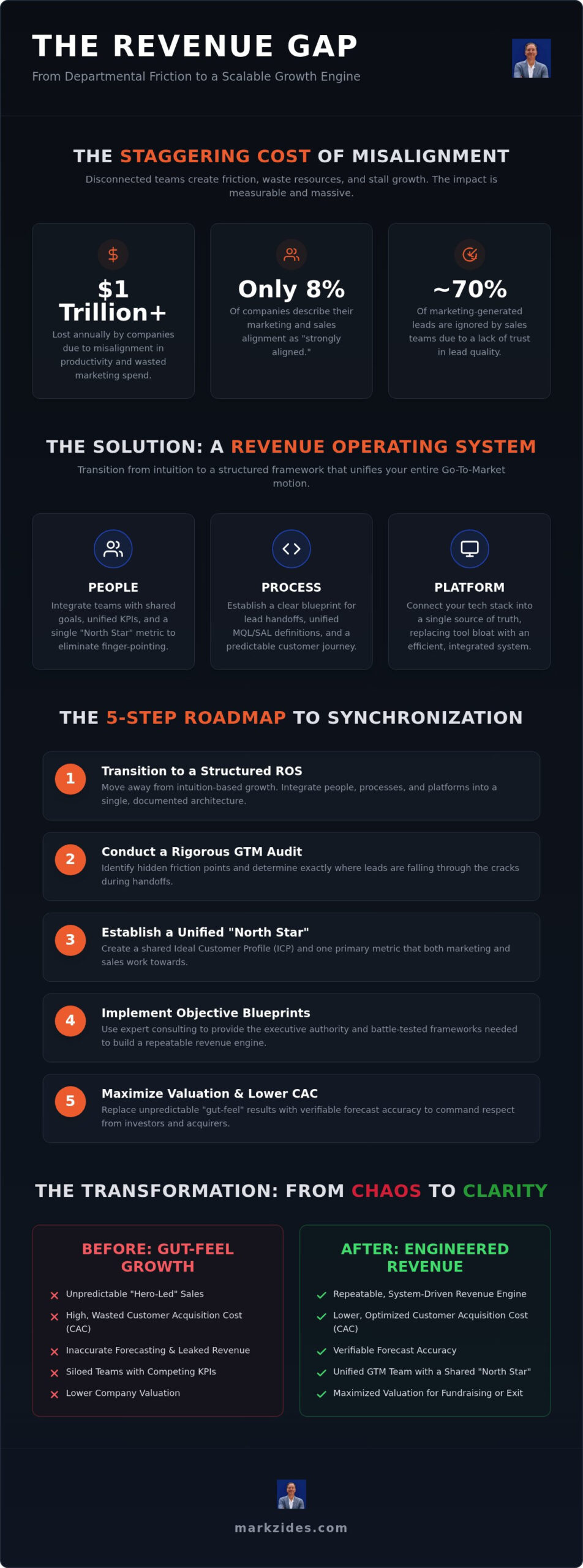
The 5-Step Roadmap to Marketing and Sales Synchronization
Generic best practices won't fix a broken revenue engine. You need a sequence that transitions your organization from fragmented activities to a synchronized machine. Professional marketing and sales alignment consulting provides this sequence by installing a rigorous implementation roadmap. This isn't about minor adjustments; it's about re-engineering the way your departments interact to ensure every effort contributes to the bottom line. To achieve scalable growth in 2026, your leadership must commit to these five critical stages:
- Step 1: Unified Revenue Goal Setting (The North Star metric).
- Step 2: Collaborative ICP and Buyer Persona definition.
- Step 3: Establishing a high-performance Service Level Agreement (SLA).
- Step 4: Integrating the tech stack for a 360-degree customer view.
- Step 5: Implementing a continuous feedback loop and performance cadence.
Step 1 & 2: Building the Strategic Foundation
Alignment begins with the North Star. You must move from "leads" to "revenue" as your primary marketing KPI. When marketing is incentivized by the same closing numbers as sales, the quality of the pipeline shifts overnight. This foundation is strengthened through collaborative ICP workshops. You cannot rely on market data alone; you must combine it with the sales-floor reality of your front-line reps. This collaborative definition ensures your roadmap aligns with the broader what is demand generation pillar, creating a unified front before a single ad is launched.
Step 3 & 4: Operationalizing the Handoff
The handoff is where revenue leaks are most prominent. A high-performance SLA defines the rules of engagement with surgical precision. It specifies response times, qualification criteria, and lead recycling rules. If a lead isn't ready to buy, it doesn't get discarded; it gets sent back to marketing for further nurturing. This operational discipline requires a tech stack that offers a 360-degree customer view. When choosing B2B lead generation services, you must prioritize those that integrate seamlessly with your internal CRM. Automation should remove friction, not create new data silos that require manual entry.
The final step is the implementation of a continuous feedback loop. This performance cadence ensures the system self-corrects through weekly pipeline reviews and monthly strategic pivots. This replaces the finger-pointing of the past with a culture of shared accountability. If your current structure cannot support this level of discipline, it's time to embed fractional CRO leadership to drive the transformation. Effective marketing and sales alignment consulting replaces the "gut-feel" of the past with a predictable, scalable blueprint for 2026 and beyond.
Fractional CRO Leadership: The Catalyst for Rapid Alignment
Self-correction is often impossible within a misaligned organization. Internal teams are frequently too buried in daily execution or hampered by office politics to identify the structural rot in their revenue engine. This is why many high-growth companies hit a plateau; they are attempting to fix the system while simultaneously trying to run it. Professional marketing and sales alignment consulting introduces the neutral authority necessary to break these cycles. A Fractional CRO acts as the Strategic Architect, providing the blueprint and the discipline to bridge the gap between departments without the overhead of a full-time executive hire.
The transition from founder-led chaos to a repeatable, executive-led revenue machine is a high-stakes pivot. If you continue to rely on the "gut-feel" of a single founder, you create a bottleneck that limits your scalability and your valuation. Investors seek businesses with predictable systems, not heroic individuals. By installing an outside expert, you ensure that your revenue strategy is built on data-driven architecture rather than personality-driven intuition. This shift is what moves a company from a series of lucky breaks to a state of forecast accuracy.
The ROI of Fractional CRO Consulting
Speed is the ultimate competitive advantage in a mid-market environment. While an internal search for a full-time CRO can take six months or more, a fractional leader can begin embedding a Revenue Operating System within weeks. Most organizations see the first signs of alignment—such as unified KPIs and a functional SLA—within the first 90 days. This objective perspective allows a consultant to prioritize revenue over ego, breaking through the silos that previously drained your resources and leaked your pipeline.
This engagement isn't just about fixing current leaks; it's about preparing your company for the next level of performance. Whether you are looking at fractional CRO services to scale for a new round of funding or to maximize your valuation for an eventual exit, the goal remains the same: sustainable growth. A strategic operator doesn't just build the system; they ensure it is load-bearing and ready for the pressures of rapid expansion.
Executive Coaching for Alignment
Maintenance is as important as construction. A Fractional CRO provides the executive coaching necessary to mentor your VPs of Sales and Marketing to think like Revenue Officers. This builds the internal leadership capacity required to maintain alignment long-term, ensuring the departments don't slide back into their old siloed habits. You aren't just buying a temporary fix; you are investing in a permanent shift in your leadership culture. When your leaders speak the same language and share the same North Star metric, the path to the next level becomes clear.
Ready to build your Revenue Operating System and eliminate the friction in your GTM strategy? Book a strategy session with Mark Zides to start your transition from uncertainty to clarity.
Engineering Your Path to Predictable Revenue
The transition from fragmented departments to a unified revenue engine is the most significant leap a mid-market company can make. By replacing "gut-feel" anxiety with a structured Revenue Operating System, you establish the forecast accuracy required for rapid scaling. We've explored how auditing friction and installing a rigorous roadmap can lower your CAC and prepare your organization for a high-value exit. This isn't just about better meetings; it's about embedding the discipline and accountability that high-growth SaaS requires to thrive in a competitive landscape.
If your internal team lacks the objectivity to bridge the gap between marketing and sales, then specialized marketing and sales alignment consulting is the catalyst you need. Utilizing battle-tested GTM blueprints and fractional CRO expertise ensures your growth is sustainable rather than accidental. You can implement a full Revenue Operating System in as little as 90 days, transforming operational chaos into a repeatable machine. Stop guessing where your revenue is leaking and start building a foundation that commands respect from your board and your competitors alike.
Move from Gut-Feel to Forecast Accuracy: Book Your Strategy Audit
The blueprint for your next level of performance is ready. It's time to build the revenue engine that your vision deserves.
Frequently Asked Questions
What is marketing and sales alignment consulting?
Marketing and sales alignment consulting is a strategic engagement that installs a Revenue Operating System to synchronize your Go-to-Market teams. It moves beyond cultural "smarketing" buzzwords to focus on the architecture of data, lead handoffs, and shared accountability. This process replaces fragmented, intuition-based tactics with a repeatable revenue engine designed for executive-level forecast accuracy and scalable growth.
How long does it take to see results from alignment consulting?
You can expect to see foundational operational shifts within 90 days. While full cultural integration is an ongoing process, the installation of unified KPIs and a functional Service Level Agreement happens rapidly. This speed to execution is a hallmark of professional marketing and sales alignment consulting, as it prioritizes fixing the most critical friction points in your funnel immediately.
What are the key KPIs for sales and marketing alignment?
Focus on shared metrics like Pipeline Velocity, Customer Acquisition Cost (CAC), and MQL-to-SQL conversion rates. The most critical metric is closed-won revenue attributed to marketing-sourced leads. This ensures both teams are incentivized by the same North Star goal rather than vanity metrics like lead volume or social engagement, which often mask underlying performance issues.
Do we need a new CRM to achieve alignment?
Not necessarily. Alignment is a process and people challenge rather than a software limitation. While your current tech stack might require reconfiguration to eliminate data silos, buying a new CRM without fixing your underlying processes will only automate your existing friction. You must fix the strategic architecture first; if the process is sound, the tools will follow.
What is the difference between a Fractional CRO and a traditional consultant?
A Fractional CRO provides executive authority and hands-on leadership, whereas a traditional consultant typically only provides advice or a static report. The CRO acts as an "Expert Operator" who embeds within your leadership team to design and execute the revenue blueprint. They take direct accountability for the results and the long-term health of your revenue engine.
How does alignment impact company valuation during an exit?
It significantly increases valuation by proving your growth is predictable, documented, and repeatable. Investors pay a premium for businesses with high forecast accuracy and low customer acquisition costs. Professional marketing and sales alignment consulting transforms a chaotic, founder-dependent business into a scalable asset that commands respect from private equity firms and strategic acquirers alike.
Can alignment consulting help with founder-led sales transitions?
Yes, this is a primary focus for mid-market companies hitting a growth ceiling. Consulting replaces the founder's intuition with a documented, systemized sales process that others can follow. It builds the leadership capacity for your VPs of Sales and Marketing to operate independently, ensuring the company's momentum doesn't stall when the founder steps back from day-to-day selling.
What should be included in a Sales and Marketing SLA?
Your SLA must define lead qualification criteria, mandatory response times, and lead recycling rules with surgical precision. It should specify the volume of leads marketing must provide and the exact percentage of those leads sales must engage within a set timeframe. This document acts as the formal contract that enforces accountability and eliminates finger-pointing between both departments.
Ready to build a revenue engine that runs without you?
Mark works alongside founders as a player-coach — not a slide deck.
Book a 30-minute call