
Founder Growth Cheat Code: Scaling Revenue Faster

Most founders believe that working harder is the only way to break through a revenue plateau, but your personal output is actually the ceiling holding your company back. You've built this business on sheer will and intuition, yet you're now facing the reality that gut-feel forecasting doesn't scale. It's exhausting to be the primary engine of every deal while your sales team underperforms without your direct intervention. You've reached the limit of founder-led growth, and the path forward requires a fundamental shift in your operational architecture.
There's a specific cheat code for founders growth that transforms this high-stakes hustle into a predictable, high-growth revenue engine. By implementing a repeatable sales process and a data-driven operating system, you can reclaim your time while driving a higher company valuation. We'll explore the strategic framework to move from operator to visionary, detailing how to embed the systems necessary for fundraising or exit readiness. It's time to stop guessing and start building a business that thrives independently of your daily involvement.
Key Takeaways
- Transition from individual founder hustle to a structured Revenue Operating System that ensures sales performance remains consistent and independent of any single person.
- Discover the 2026 cheat code for founders growth by replacing raw outbound volume with a trust-driven, systemic execution model that resonates with modern buyers.
- Scale faster by leveraging partner-led growth strategies that tap into hyperscale markets and create sustainable, indirect revenue streams through the "Give to Get" philosophy.
- Prepare for a high-value exit by utilizing fractional CRO services to build the operational maturity and predictable forecasting that sophisticated investors and acquirers demand.
The 2026 Growth Reality: Why Traditional Founder Hustle Is Failing
Ambition isn't the problem; it's the bottleneck. In 2026, scaling revenue requires more than just grit and late nights. The true cheat code for founders growth is the deliberate transition from individual effort to systemic execution. If your growth depends on your personal calendar, you aren't building a company; you're managing a high-stress job. You must move from being the engine to being the architect of a system that functions without your constant intervention.
The Trust Deficit in Modern B2B Buying
Raw outbound volume has become noise. Modern buyers face choice overload and deep skepticism, leading them to prioritize risk mitigation through verified relationships. They turn to trusted peers and industry partners long before engaging with traditional marketing collateral. Partner-Led Growth is the strategic leverage of existing trust ecosystems to drive revenue through established credibility. By embedding your solution within these networks, you bypass the friction of cold outreach and align with how complex decisions are actually made today.
The High Cost of Founder-Led Sales
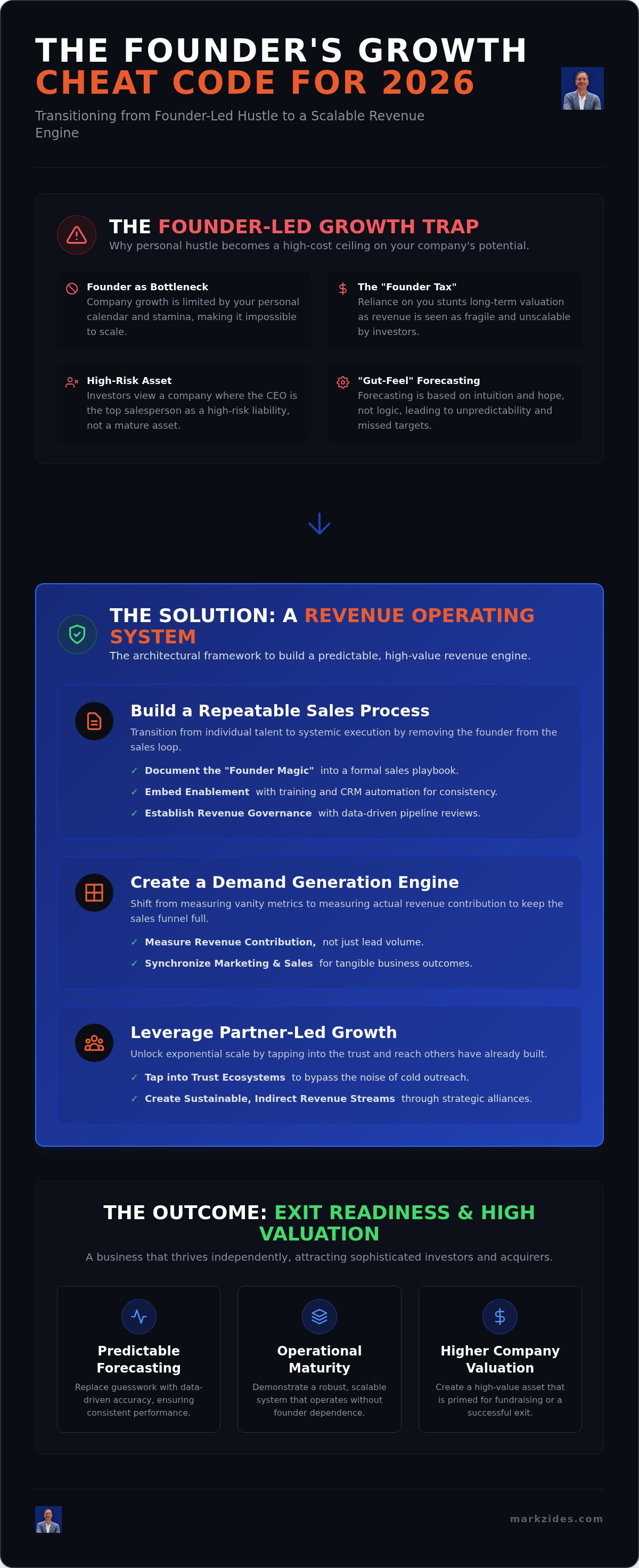
Reliance on founder-led sales creates a "founder tax" that stunts long-term valuation. Investors view a company where the CEO is the top salesperson as a high-risk asset because the revenue is fragile and inherently unscalable. If you're in every closing call, your company lacks the operational maturity needed for a clean exit. This dependency creates a ceiling on your ARR and makes your forecasting a matter of luck rather than logic. It's an expensive way to run a business that eventually hits a hard plateau.
Breaking this cycle requires a Revenue Operating System. This architectural framework replaces "gut-feel" with repeatable processes. It ensures that growth is a function of the system rather than the founder's stamina. When you align your team around a structured methodology, you transform a fragile hustle into a predictable, high-value asset ready for the next level of performance.
Decoding the Revenue Operating System: Beyond Founder-Led Sales
Scaling revenue isn't a talent problem; it's an architecture problem. If your success depends on your personal charisma, your growth is inherently limited. The real cheat code for founders growth is the implementation of a Revenue Operating System where every deal follows a predictable, documented path. This machine must be repeatable, measurable, and entirely independent of any single person. It starts with robust sales enablement, which provides the playbooks and tools your team needs to close deals without your presence in the room.
Removing the Founder from the Sales Loop
Replacing yourself requires a disciplined approach to operational maturity. You can't just hand off a list of leads; you must hand off a methodology. To help you build these essential management skills, check out MACH-10 Leadership. This transition involves three critical pillars:
- Document the "Founder Magic": Turn your intuitive closing techniques into a formal, repeatable sales playbook that others can execute.
- Embed Enablement: Provide the team with precise training and CRM automation to ensure execution remains consistent across the board.
- Establish Revenue Governance: Shift to weekly pipeline reviews focused on data-driven accountability rather than anecdotal updates.
Building the Demand Generation Engine
A high-performing sales team is useless if the funnel runs dry. Your marketing efforts must shift from measuring vanity metrics like lead volume to measuring actual revenue contribution. Understanding what is demand generation is the first step in aligning your marketing spend with tangible sales outcomes. When your demand engine and sales execution are synchronized, your forecast accuracy moves from "gut-feel" to a reliable business metric. If you're looking to accelerate this transition, fractional CRO services can provide the tactical leadership needed to build these systems.
The Multiplier Effect: Partner-Led Growth and Indirect Revenue
Scaling through direct sales alone is a linear path to exhaustion. To unlock exponential scale, you must leverage the trust others have already built. A sophisticated partnerships and alliances strategy acts as a trust-proxy, allowing you to bypass cold outreach and enter deals with pre-established credibility. This is a vital component of the cheat code for founders growth. It shifts your focus from chasing individual leads to engineering a multiplier effect across entire ecosystems.
Developing a Hyperscaler Strategy
Success in 2026 requires identifying partners who already own your target customer’s primary business relationship. You aren't just looking for resellers; you're looking for strategic alignment with hyperscalers. By creating formal programs that incentivize these partners to advocate for your solution, you gain access to global markets that would otherwise take years to penetrate. This isn't about passive referral links; it's about embedding your value proposition into their existing service delivery models to ensure your solution is the default choice.
Mastering the Art of Matchmaking
The "Give to Get" philosophy is the foundation of high-performing alliances. Most competitors fail here because they treat partners as a one-way lead source. You win by being the partner who provides the most value first. This means doing the simple things: providing co-branded assets, offering technical support, and ensuring partner-attributed revenue is tracked with precision. Data-driven relationship management ensures you remain top-of-mind when your partners are in the room with your ideal customers. Recent data suggests that mature partner programs can contribute up to 28% of a company's total revenue, making this an essential pillar of your growth engine.
When you integrate partner leads into your standard sales execution workflow, your win rates increase while your sales cycles shrink. If you're ready to build a scalable indirect revenue engine, explore our Partnerships & Alliances Strategy to start engineering your growth multiplier today.
Implementing the Cheat Code: Fractional CRO and Exit Readiness
Scaling a business to its full potential requires a shift from founder-led grit to institutionalized discipline. While many entrepreneurs attempt to hire a full-time executive too early, the true cheat code for founders growth lies in leveraging specialized expertise to build the foundation first. This is where fractional CRO services become indispensable. They offer a low-risk, high-ROI method to embed a Revenue Operating System without the immediate overhead of a permanent C-suite salary.
Fractional CRO vs. Full-Time Hire
Hiring a full-time CRO before your systems are mature often leads to expensive turnover. You need a builder, not just a manager. Fractional leadership provides "operator-immersive" support, meaning they don't just hand you a strategy deck; they embed the tools, playbooks, and cadences into your daily operations. This approach ensures your revenue engine is built on a solid architectural blueprint, allowing you to hire a permanent leader later who can simply fuel an existing, high-performing machine.
Maximising Valuation for Fundraising and Exit
Predictability is the primary currency of company valuation. VCs and acquirers aren't just buying your current ARR; they're buying the certainty of your future growth. Through exit readiness consulting, you can align your operational maturity with investor expectations by proving your lead sources are diverse and your sales cycles are repeatable. Executive coaching further supports this by helping you transition from a tactical operator to a strategic architect. Operational discipline is the ultimate driver of company valuation. When the business no longer relies on your personal involvement to close deals, you've created a truly scalable asset that commands a premium. By mastering this cheat code for founders growth, you ensure your company is both unshakeable and exit-ready.
Architecting Your Exit-Ready Future
Scaling revenue isn't about working more hours; it's about building better systems. You've seen how the 2026 landscape demands a shift from founder-led hustle to a structured Revenue Operating System. By embracing partner-led growth and removing yourself from the daily sales loop, you transform your company from a fragile startup into a high-value asset. This transition is the ultimate cheat code for founders growth, replacing "gut-feel" anxiety with the clarity of predictable, data-driven execution.
True operational maturity requires more than just advice; it requires an immersive operator who has been in the trenches. Mark Zides specializes in removing founder-led sales bottlenecks and preparing high-growth startups for maximum valuation. If you're aiming for a strategic fundraising round or a clean exit, the right architecture makes all the difference. Stop being the engine and start being the architect of your own success. Schedule a strategy session with Mark Zides to build your Revenue Operating System and secure the future your hard work deserves. You've built the foundation; now it's time to scale it.
Frequently Asked Questions
What is the most effective cheat code for founders to scale sales?
The most effective cheat code for founders growth is the transition from individual effort to a systemic Revenue Operating System. Instead of relying on your personal charisma to close deals, you must embed repeatable processes that empower your team to execute independently. This shift replaces "gut-feel" with predictable data. It ensures that your company's revenue trajectory is a function of the system's architecture rather than your personal stamina or daily calendar.
How do I know if I need a Fractional CRO or a VP of Sales?
You need a Fractional CRO when your revenue systems don't exist yet or have plateaued due to operational friction. While a VP of Sales focuses on managing a team and hitting quotas, a Fractional CRO is an architect who builds the underlying blueprint for scale. If your sales process is inconsistent or still relies heavily on your involvement, hiring a builder to design the machine is more efficient than hiring a manager to run a broken one.
What is the difference between founder-led sales and a repeatable sales process?
Founder-led sales rely on your unique intuition, deep product knowledge, and personal relationships to close deals. While effective early on, it isn't scalable. A repeatable sales process is a documented methodology that any trained representative can follow with consistent results. It uses standardized playbooks and sales enablement tools to ensure that every prospect receives the same high-value experience. This transition is essential for building a company that functions without your constant oversight.
How can partner-led growth accelerate my startup’s revenue?
Partner-led growth accelerates revenue by leveraging the trust and customer access already established by industry hyperscalers. Instead of fighting for attention in crowded outbound channels, you enter deals through a "trust-proxy" that shortens sales cycles and increases win rates. By aligning your solution with a partner's existing ecosystem, you create a multiplier effect. This strategy allows you to tap into hyperscale markets with significantly lower customer acquisition costs than traditional direct sales.
What steps should a founder take to prepare for an exit in 2026?
Preparing for an exit requires a focus on operational maturity and revenue predictability. You must prove that your growth is sustainable and independent of your personal involvement. This involves diversifying lead sources, implementing a robust Revenue Operating System, and ensuring your forecasting is based on clean data rather than optimism. Investors and acquirers pay a premium for businesses that demonstrate clear scalability and have a battle-tested leadership structure already in place for the next phase.
Ready to build a revenue engine that runs without you?
Mark works alongside founders as a player-coach — not a slide deck.
Book a 30-minute call