
The B2B Startup Scaling Framework for 2026: Building a Predictable Revenue Engine

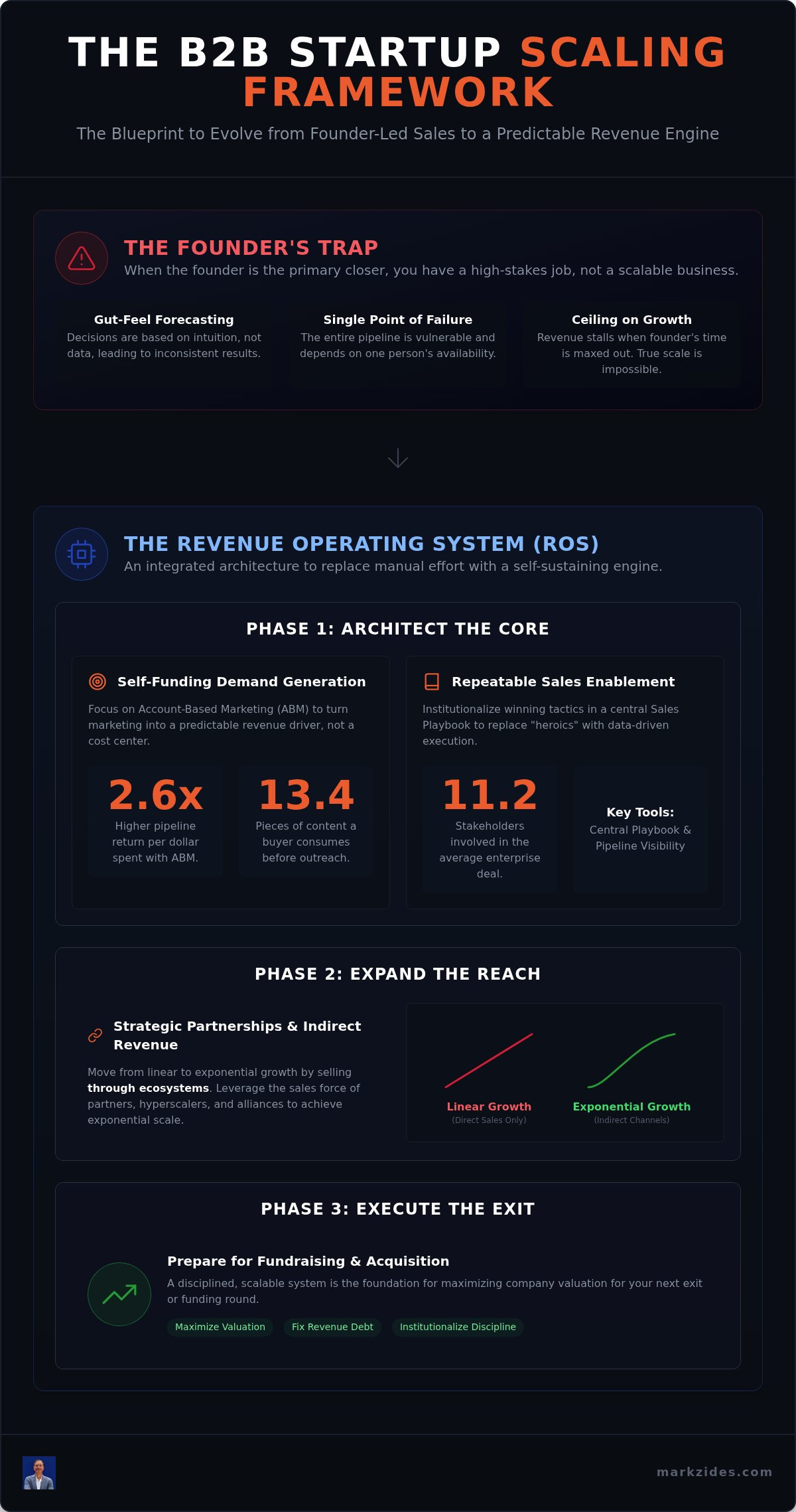
If your revenue growth still depends on your personal ability to close deals, you don't have a scalable business; you have a high-stakes job that's hitting a ceiling. It's a common trap where the founder remains the primary closer, leaving the pipeline vulnerable to gut-feel forecasting and inconsistent results. You know that for your startup to survive the transition to a Series B or a major exit, you must step back from the front lines and build something that outlasts your own effort.
Implementing a comprehensive B2B startup scaling framework is the only way to replace this manual labor with a self-sustaining revenue engine. This article provides the architectural blueprint to move from founder-led chaos to a structured operating system. We'll detail how to align your sales enablement, optimize for the 11.2 stakeholders now involved in every major deal, and embed the discipline required for maximum valuation. You're about to learn how to build a predictable system that delivers results without your constant intervention.
Key Takeaways
- Transition from proving value to building systems by implementing a robust B2B startup scaling framework designed for the 2026 market.
- Align demand generation and sales enablement through shared KPIs to eliminate founder-led dependency and build a self-sustaining pipeline.
- Accelerate growth by identifying and embedding strategic partnerships and hyperscaler alliances into your core revenue engine.
- Maximize company valuation for your next exit or funding round by fixing revenue debt and institutionalizing operational discipline.
The Revenue Operating System: Why Your B2B Startup Scaling Framework Must Evolve
Scaling in 2026 requires more than a series of disconnected growth hacks. It demands a Revenue Operating System (ROS). A modern B2B startup scaling framework is a multi-layered architecture that integrates demand generation, sales execution, and customer success into a single, predictable unit. The transition from "Zero to One" was about proving value; moving from "One to Ten" is about building systems. For those scaling into medium-sized enterprises, Inspired Leadership provides the transformational journeys required to evolve leadership capabilities alongside the business architecture. If you're still relying on sheer hustle, you're inviting a Revenue Stall where activity increases but results plateau. You need strategic architecture to replace intuition with infrastructure.
Moving Beyond Founder-Led Sales Reliance
The "Founder-as-Closer" model is your biggest liability. It creates a single point of failure and masks underlying gaps in your messaging. For long-term valuation, you must institutionalize your expertise. This process requires scaling beyond founder-led sales by distilling your unique insights into a repeatable sales playbook. Document every objection, refine every script, and map the buyer journey. If the system cannot run without your personal intervention, you haven't built a company; you've built a job.
The Pitfalls of Premature Professionalization
Hiring a high-priced VP of Sales too early is a common path to wasted equity and high churn. These executives are typically operators designed to run established machines, not architects capable of building them from the ground up. If the blueprint isn't set, they'll struggle to find traction. Fractional CRO leadership provides a more surgical solution. It allows you to embed the necessary strategy and systems before committing to a heavy executive hire. Similarly, for businesses seeking senior marketing leadership and AI consulting, Sean Brightman provides the strategic roadmapping and fractional leadership that integrates seamlessly into this growth architecture. Build the engine. Then hire the driver.
Architecting the Core: Demand Gen and Sales Enablement Alignment
To build a predictable revenue engine, you must stop treating marketing and sales as separate departments. Within a high-performing B2B startup scaling framework, these functions act as a single, synchronized unit. Demand generation is the strategic alignment of market awareness and sales readiness. If your marketing team focuses on raw lead volume while your sales team starves for quality, your engine is broken. You need shared revenue KPIs, unified lead definitions, and a relentless focus on the account-based revenue strategies that drive growth in 2026. This alignment ensures that every touchpoint moves the buyer closer to a decision. If you are looking to dominate your market through better visibility, you can visit Peter Montoya to explore SEO performance marketing and growth coaching services.
Stop chasing vanity metrics. High-growth operators understand what is demand generation and how to leverage it for sustainable pipeline. In 2026, account-based marketing (ABM) delivers a 2.6x higher pipeline return per dollar spent compared to traditional broad-reach efforts. Since buyers now consume an average of 13.4 pieces of content before reaching out, your engine must provide high-value assets that build trust autonomously. This self-funding model ensures that every marketing dollar invested directly accelerates your path to the next funding round. It transforms marketing from a cost center into a predictable revenue driver.
Sales Enablement: Equipping Teams for Repeatable Success
A scalable business cannot rely on individual heroics. You must develop a central "Sales Playbook" that institutionalizes winning tactics and equips your team to navigate the 11.2 stakeholders now involved in the average enterprise deal. Sales enablement is not a one-time training session; it is a continuous function of tool-optimization and execution discipline. Implementing real-time pipeline visibility tools ensures accountability across the board. To ensure your architecture is sound, consider partnering with an expert in sales execution and enablement to bridge the gap between strategy and closed deals. This structure replaces gut-feel with data-driven execution.
Expanding the Reach: Strategic Partnerships and Indirect Revenue
Relying solely on direct sales is a linear growth strategy in a compounding market. To achieve exponential scale, your B2B startup scaling framework must incorporate indirect revenue channels as a primary accelerator. In 2026, the most successful operators don't just sell to customers; they sell through ecosystems. This requires identifying hyperscalers and alliances that align with your core product value and designing a formal program that incentivizes third-party growth. If you aren't leveraging the sales force of your partners—or the collective influence of your own leadership team—you're leaving significant market share on the table. To maximize your presence in these professional ecosystems, you can learn more about Leaders Social and their specialized training for turning professionals into influential industry thought leaders.
Developing Hyperscaler and Channel Alliances
Crafting a sophisticated partnerships and alliances strategy is essential for expanding your reach without a proportional increase in CAC. The "Co-Sell" motion is the tactical heart of this approach. By aligning your sales team with partner representatives, you can leverage their existing trust and enterprise relationships to close larger deals faster. This isn't about passive referrals. It's about active, coordinated execution where both parties benefit from the transaction's success.
Integrating RevOps for Forecast Accuracy
Indirect channels often fail because of poor data visibility. You must integrate RevOps to establish a single source of truth for both direct and indirect sales data. This alignment allows you to identify friction points in the scaling process and forecast channel performance with precision. If you can't measure it, you can't scale it. To build these high-growth alliances effectively, you should seek an expert partnerships and alliances strategy to navigate the mechanics of hyperscaler ecosystems. This discipline transforms partnerships from a "nice-to-have" into a predictable revenue driver.
Executing the Exit: Preparing for Fundraising and Acquisition
The final validation of your B2B startup scaling framework isn't just reaching a revenue milestone; it's the successful execution of an exit or a major funding round. Investors don't just buy your current ARR. They buy the predictability and scalability of your revenue engine. If your growth is tied to inconsistent processes or "heroics" from a few individuals, you're carrying significant revenue debt that will be exposed during due diligence. Cleaning up messy data and institutionalizing operational excellence are the primary drivers of company valuation in 2026. Documented industry outcomes show that implementing a standardized scaling framework can increase exit multiples by 20% or more by reducing perceived risk and demonstrating a clear path to future growth. Just as you rely on a framework for business growth, managing the personal real estate transitions that often accompany a successful exit requires the guidance of a dedicated professional like Dr. Zakk Varughese, Real Estate Broker - HomesRX.
Operational Optimization for Maximum Valuation
Preparing for an exit requires a cold, analytical look at your internal systems. Utilizing a structured exit readiness consulting framework allows you to identify and bridge valuation gaps before you sit down with VCs or private equity firms. You must prove that your revenue growth is sustainable, profitable, and entirely independent of founder intervention. If you can't show a clear map of how a dollar of investment turns into three dollars of pipeline, you aren't ready for the scrutiny of a high-stakes exit process.
The Strategic Advantage of Fractional CRO Leadership
Building this architecture while running a company is a massive operational burden. Professional fractional CRO services offer the most efficient path to implement a scaling framework without the overhead of a permanent executive hire. These operators don't just fix the plumbing; they mentor your internal leaders to take over the system as the company matures. This ensures the engine continues to hum long after the transition, providing the stability and confidence that premium buyers demand.
Architecting Your Path to Predictable Scale
Scaling is no longer about increasing headcount; it's about refining your internal architecture. By implementing a robust B2B startup scaling framework, you replace the volatility of founder-led sales with the precision of a Revenue Operating System. You've seen how aligning demand generation with enablement and leveraging indirect partnerships can accelerate your trajectory while preparing your organization for the scrutiny of a high-stakes exit. The objective is to move from a state of constant reaction to one of structured, predictable performance.
Building this engine requires more than high-level strategy. It requires the hands-on expertise of an operator who has navigated these high-growth environments before. If you're ready to stop guessing and start building, it's time to professionalize your revenue function. Scale your revenue with a Fractional CRO who has been in the trenches. Benefit from battle-tested revenue blueprints, executive coaching for high-growth founders, and a relentless focus on sustainable multiples. You have the vision. Now, it's time to embed the systems that make your success inevitable.
Frequently Asked Questions
What are the core pillars of a B2B startup scaling framework in 2026?
The core pillars of a 2026 B2B startup scaling framework include a centralized Revenue Operating System, synchronized demand generation, and an active partnership ecosystem. It requires shifting from volume-based lead generation to high-quality account-based revenue strategies. Additionally, you must embed RevOps to ensure data integrity across both direct and indirect channels. These pillars work together to replace founder-led hustle with a repeatable, predictable engine that drives sustainable growth.
When is the right time to transition from founder-led sales to a professional sales team?
You should transition once you've achieved consistent product-market fit and can document a repeatable sales process. If you're still the only person who can close deals, the business isn't yet scalable. The ideal window usually opens after your first ten non-referral sales. At this stage, you need to institutionalize your knowledge into a playbook so that professional sellers can execute without your direct intervention on every call.
How does a fractional CRO help with scaling a B2B startup?
A fractional CRO acts as the strategic architect of your revenue engine, designing the systems that a full-time hire will eventually run. They provide executive-level leadership without the high overhead of a permanent hire. By implementing a battle-tested B2B startup scaling framework, they help you avoid premature professionalization. They focus on fixing revenue debt, aligning sales with marketing, and preparing the organization for the scrutiny of future funding rounds.
What is the difference between growth hacks and a revenue operating system?
Growth hacks are isolated, short-term tactics designed for quick wins, while a revenue operating system is a permanent infrastructure for long-term scale. Hacks often ignore the underlying mechanics of sales enablement and data visibility. A true system integrates every function into a logical, compounding workflow. If a tactic can't be measured, repeated, or forecasted with precision, it's a hack, not a component of a scalable revenue operating system.
How can a scaling framework improve my company's valuation before an exit?
A scaling framework increases valuation by proving that your revenue is predictable and independent of founder effort. Investors apply higher multiples to companies with documented, repeatable systems and clean data. By eliminating revenue debt and showing a clear, data-backed path to future growth, you reduce the perceived risk for buyers. This operational discipline demonstrates that the company is a self-sustaining asset, which can increase exit multiples by 20% or more.
Ready to build a revenue engine that runs without you?
Mark works alongside founders as a player-coach — not a slide deck.
Book a 30-minute call