
Scaling Beyond Founder-Led Sales: The 2026 Strategic Blueprint

Your intuition is the single greatest threat to your company's next stage of growth. While your personal ability to close deals built the foundation, that hero energy is now the primary bottleneck capping your ARR. You're likely exhausted by the weight of every major contract and the anxiety of unpredictable revenue cycles. It's a common trap: believing that your unique magic is the only thing keeping the lights on. However, scaling beyond founder-led sales requires a fundamental shift from individual brilliance to systemic excellence. If you don't build a bridge to autonomy now, you'll remain a prisoner to your own success.
You know that the current pace is unsustainable, yet the fear of hiring reps who might burn your best leads keeps you stuck in the weeds. This guide provides the strategic remedy. You'll learn how to transition from hero-based selling to a repeatable revenue engine that operates without you in every room. We'll examine the architectural blueprints for a sales team that functions autonomously. This gives you the freedom to focus on high-level strategy and product innovation. By the end of this blueprint, you'll have a clear methodology for building a predictable, forecastable stream of growth that no longer relies on your personal calendar.
Key Takeaways
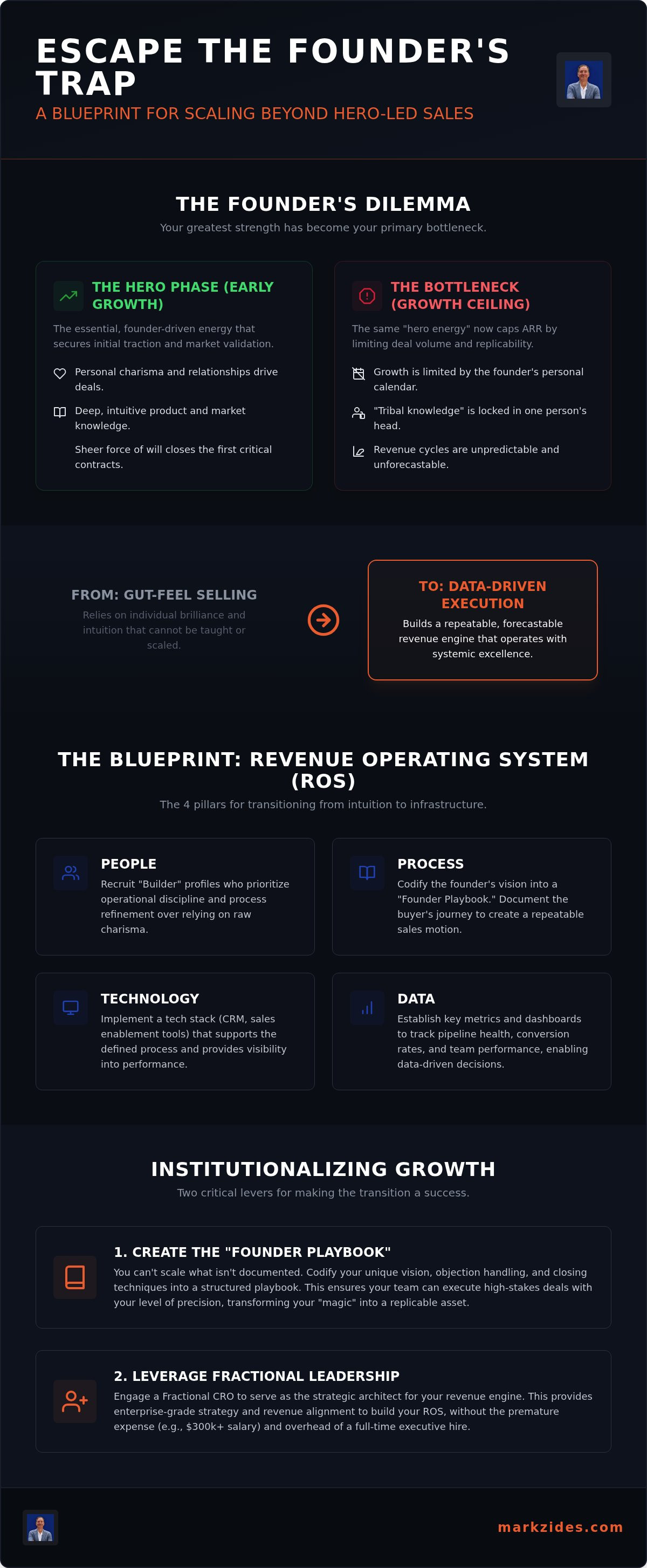
- Identify the "Hero Phase" ceiling where your personal charisma and intuition transition from growth drivers to your company's primary bottlenecks.
- Replace founder-led intuition with a structured Revenue Operating System (ROS) that aligns people, process, technology, and data into a repeatable engine.
- Codify your unique vision and closing techniques into a "Founder Playbook" to ensure your team can execute high-stakes deals with your level of precision.
- Master the transition of scaling beyond founder-led sales by recruiting "Builder" profiles who prioritize operational discipline and process refinement over raw charisma.
- Leverage fractional CRO leadership to embed enterprise-grade strategy and revenue alignment without the premature expense of a full-time executive hire.
The Founder’s Dilemma: Why Founder-Led Sales Hits a Ceiling
Founder-led sales is often celebrated as the "Hero Phase" of a startup's journey. It's a period defined by your individual charisma, deep product knowledge, and the sheer force of will required to win initial contracts. While this energy is essential for early traction, it eventually creates a structural ceiling that prevents true expansion. The "Founder Bottleneck" occurs when deal volume finally exceeds your available hours, turning the CEO into the company's most expensive and restrictive constraint. If every major negotiation requires your presence to cross the finish line, your growth is limited by your personal calendar rather than market demand.
The primary risk during this phase is the accumulation of "Tribal Knowledge." You know how to pivot a conversation or handle a specific objection based on years of context that your team simply doesn't have. Because these insights remain locked in your head, your results are impossible to replicate. Scaling beyond founder-led sales requires a fundamental shift from "Gut-Feel" selling to "Data-Driven" execution. You must replace intuition with a formal sales management framework that relies on rigorous systems rather than individual magic.
The Psychology of the Sales Exit
Stepping back from the front lines requires a mental shift from being the "Closer" to becoming the "Strategic Architect" of the revenue engine. Many founders struggle with this transition because they fear their first sales hires will cause brand damage by misrepresenting the vision. However, the Founder's Trap is the moment when the CEO's involvement decreases deal velocity. If your presence is required to validate every promise, your sales cycle remains bloated and inefficient. You aren't losing control; you're gaining leverage by embedding your expertise into a repeatable process that others can execute.
Recognising the Breaking Point in 2026
In the high-stakes business environment of 2026, the breaking point is often signaled by a stagnant pipeline despite high activity levels. You might see deals stalling at the final stage or a significant gap between your personal closing rate and that of your team. These inefficiencies don't just hurt your current revenue; they suppress your company valuation. Investors and buyers look for operational excellence that functions independently of the founder. If you want to prepare for a successful exit, you must invest in CEO coaching for revenue growth to navigate this leadership transition. True scale is only possible when your revenue engine runs on a blueprint, not your personal stamina.
Building the Revenue Operating System: From Intuition to Infrastructure
Scaling isn't a hiring problem; it's an architectural one. To achieve success in scaling beyond founder-led sales, you must replace your personal intuition with a Revenue Operating System (ROS). This system acts as the structural foundation for your growth, integrating People, Process, Technology, and Data into a single, cohesive unit. Without this alignment, your sales and marketing teams will operate as disconnected silos. Marketing might generate volume, but if sales isn't equipped to close those specific profiles, the engine stalls. Professionalizing these functions ensures that revenue becomes a predictable output of your system rather than a byproduct of your personal effort.
A Fractional CRO serves as the Strategic Architect for this transition. They design the system the founder lacks, providing the executive leadership needed to align revenue streams without the $300k+ overhead of a full-time hire. They focus on the mechanics of the engine, ensuring that every part of the funnel is optimized for conversion. This transition is the most critical hurdle when scaling beyond founder-led sales. If you're ready to stabilize your growth, focusing on operational excellence can provide the clarity needed to lead this structural shift.
Defining Your Repeatable Sales Process
You can't scale what you haven't documented. Mapping the buyer's journey from the first touchpoint to a closed-won contract is the first step in creating a repeatable engine. By identifying specific "Stage Gates", measurable criteria that a prospect must meet to move through the funnel, you create a predictable path for every deal. These gates remove the ambiguity of gut-feel updates in your pipeline meetings. This level of clarity is a hallmark of a business coach for entrepreneurs who specializes in building high-performance revenue teams.
Technology as the Truth: CRM and Sales Stack
In 2026, spreadsheets are where revenue goes to die. Your CRM must serve as the Single Source of Truth for every interaction. Modern sales stacks now include automated sequencing, real-time coaching tools, and AI-driven intent data to help your team prioritize high-value targets. However, technology only works if your data hygiene is impeccable. If your data is messy, your revenue forecasting will be pure fiction. Understanding how to structure a scaling sales team involves selecting tools that enforce discipline rather than just recording activity. This ensures that every decision you make is backed by hard evidence rather than a founder's hunch.
Sales Enablement: Equipping the Team to Sell Like a Founder
Sales enablement isn't a luxury; it's the tactical bridge between founder intuition and team autonomy. When scaling beyond founder-led sales, you must move beyond generic sales training. True enablement means equipping your reps with the specific tools, assets, and intelligence required for high-stakes execution. If your team lacks the resources to navigate complex negotiations without your intervention, you haven't enabled them; you've merely hired them. You must embed your expertise into the team's daily workflow so they can represent the company with the same authority you do.
A high-performance sales team is only as good as the pipeline feeding it. To maintain momentum while your internal team ramps up, utilizing Outsourced Lead Generation can be a strategic necessity. This approach ensures your reps focus on closing high-value deals rather than getting bogged down in top-of-funnel prospecting. It provides the consistent lead flow required to test your new systems without risking a revenue dip. If you don't feed the engine predictably, even the best sales reps will fail to deliver the growth you expect.
The Playbook: Codifying Your Secret Sauce
The "Founder Playbook" is the cornerstone of institutionalizing your success. It extracts your years of "gut-feel" and transforms them into repeatable scripts, objection handlers, and discovery frameworks. This playbook must be a living document updated quarterly based on real-time market feedback and shifting competitive landscapes. Beyond simple scripts, your team needs a robust library of case studies and verified proof points. These assets allow reps to build trust quickly, proving that your solution delivers results even when the founder isn't the one making the promise.
Building Rapport at Scale
One of the most difficult skills to transfer is the ability to command a room and establish executive presence. You must teach new hires how to move beyond transactional selling to create strategic connections with C-suite decision-makers. This requires mastering the nuances of building rapport through active listening and value-first communication. Many organizations benefit from sales execution consulting during this phase to provide objective feedback on rep performance. When your team can build trust as effectively as you do, you've successfully removed yourself as the primary closing factor.
Hiring and Leading the First Non-Founder Sales Team
Hiring your first sales team is an exercise in building, not just recruiting. To succeed in scaling beyond founder-led sales, your first hires must be "Builders" rather than "Scalers". A Scaler thrives in a mature environment with established leads and rigid processes; a Builder, however, excels in the ambiguity of a growing startup. They don't just follow the playbook; they help you refine it. This distinction is critical to prevent the common mistake of hiring a high-performing rep from a corporate giant who fails without a massive support structure.
Follow this methodical sequence to embed your first team and ensure long-term stability:
- Step 1: Identify the Builder Profile. Look for reps who have a track record of creating processes where none existed. They should prioritize operational discipline over raw charisma.
- Step 2: Implement a Structured Interview Process. Focus your evaluation on coachability and the ability to handle complex, multi-stakeholder deals. Use role-play scenarios to test their real-time adjustment skills.
- Step 3: Establish a 30-60-90 Day Onboarding Plan. Prioritize "system mastery" over immediate closing. Ensure they understand the CRM, the "Founder Playbook", and the buyer's journey before they take their first solo call.
- Step 4: Define Clear KPIs. Track leading indicators like discovery calls completed and pipeline velocity rather than just lagging indicators like closed revenue.
- Step 5: Transition to Mentor. Shift your focus from the front lines to executive leadership. Use this time to coach your team on the nuances of your industry while allowing them the space to execute.
Managing the Transition: From Doing to Leading
Your role must evolve from the primary closer to the strategic mentor. Conducting effective sales 1-on-1s is the first step in this evolution. Instead of obsessing over individual deal status, focus on pipeline health and process adherence. This ensures the system is functioning correctly even when you aren't looking. You must balance rep autonomy with strict accountability to the Revenue Operating System. For founders struggling with this shift, executive coaching for sales leaders provides the framework to lead through systems rather than personal involvement.
The Compensation Model for Scalability
Design incentive plans that align rep behavior with long-term revenue goals. If you only reward the final signature, you risk reps developing "commission breath", a desperation that erodes trust with prospects. Instead, incentivize the documentation of new sales insights and the maintenance of data hygiene. This aligns their success with the health of your overall infrastructure. When reps are rewarded for both performance and process, they become invested in the company's growth beyond their own commission check. If you are ready to build a team that operates with professional precision, explore our Sales Execution & Enablement services to bridge the gap to autonomy.
Institutionalising Growth: The Role of Fractional Leadership
Hiring a full-time Chief Revenue Officer (CRO) is often a premature move for companies in the early stages of scaling beyond founder-led sales. While the need for executive leadership is real, the $300k+ annual price tag of a permanent hire can drain capital that should be invested in lead generation or sales talent. Most organizations at this stage don't need a career executive to manage a steady state; they need a strategic architect to build the foundation from scratch. Fractional leadership provides this high-level expertise without the long-term overhead, allowing you to deploy enterprise-grade strategies on a flexible, results-oriented basis.
A fractional leader focuses on systemizing the revenue engine so it functions as a predictable machine rather than a series of heroic efforts. They bring a battle-tested methodology to your organization, identifying the specific leaks in your funnel and embedding the necessary rigor to fix them. This approach prepares your company for fundraising and exit readiness by proving that revenue is a product of your infrastructure, not your personal involvement. If you want to understand how this model accelerates growth, explore the benefits of fractional CRO services to bridge the gap between founder-led wins and institutional success.
The Bridge to a Permanent Revenue Leader
The transition to a permanent VP of Sales or CRO is much smoother when the incoming leader inherits a machine rather than a mess. A fractional CRO uses their tenure to hire, onboard, and train your eventual full-time leadership, ensuring they're aligned with the established Revenue Operating System from day one. They document the processes and set the KPIs that the permanent hire will eventually manage. The Fractional CRO's primary goal is obsolescence through successful systemisation. By the time you make a full-time executive hire, the risk has been mitigated and the path to scale is already paved.
Maximising Valuation Through Scalable Sales
Investors pay a significant premium for businesses that don't rely on the founder to sell. When your revenue is tied to your personal calendar, your company is a high-paying job; when it's tied to a repeatable system, it becomes a scalable asset. Systematized revenue is the most powerful lever you have for increasing your multiple during a sale or funding round. You must demonstrate that your sales team can hit targets consistently using the "Founder Playbook" and the ROS infrastructure. Engaging in exit readiness consulting ensures that every part of your sales organization is optimized for valuation. This is the final step in the journey: transforming your personal expertise into a durable, independent engine of growth.
From Founder Brilliance to Systemic Excellence
Your company's growth is no longer limited by your personal stamina. By shifting from intuition to a structured Revenue Operating System, you replace "gut-feel" anxiety with the calm of predictable growth. Success in scaling beyond founder-led sales requires more than just hiring reps; it demands a comprehensive architectural shift that includes sales enablement, builder-focused recruitment, and fractional leadership. You've now seen the blueprint for transitioning from the primary closer to the strategic architect of a high-performance revenue engine.
Mark Zides is an expert in Fractional CRO and revenue architecture who specializes in sales execution and enablement. With a proven track record in exit readiness and valuation maximization, he provides the discipline and accountability needed to reach the next level. Stop being the bottleneck in your own organization and start building a business that grows autonomously. Scale your revenue operations with Mark Zides' Fractional CRO Services and secure your company's future. The path to a scalable, high-value asset starts with a single strategic decision. You've built the foundation; now it's time to build the legacy.
Frequently Asked Questions
What is the first hire I should make to move away from founder-led sales?
Your first hire should be a "Builder" Account Executive who thrives in ambiguity. Unlike a traditional "Scaler" rep, a Builder helps you document and refine the sales process while closing deals. Hiring a junior SDR too early often fails because they lack the mature infrastructure needed to succeed. A Builder acts as your tactical partner, helping you transition from individual charisma to a repeatable revenue system.
How do I know if my sales process is actually repeatable?
A process is repeatable when a non-founder can move a prospect through the funnel at a consistent conversion rate using documented "Stage Gates." If your team frequently asks what the next step is or relies on you to handle specific objections, your process is still intuitive rather than systemic. True repeatability is achieved when your revenue becomes a predictable output of your infrastructure instead of your personal intervention.
When is the right time to hire a Fractional CRO vs. a full-time VP of Sales?
Hire a Fractional CRO when you need to build the Revenue Operating System from scratch; hire a VP when you need to manage an existing, high-performing machine. Most companies hitting the $1M to $3M ARR milestone don't need a $300k permanent executive yet. A Fractional CRO provides the strategic blueprint and leadership required for scaling beyond founder-led sales without the long-term overhead of a full-time hire.
Can a salesperson really sell my vision as well as I can?
Yes, provided you codify that vision into a formal Founder Playbook. Your "magic" is actually a series of strategic connections and objection handlers that can be documented and taught. Through rigorous sales enablement, you equip your team to establish executive presence and build rapport. When you institutionalize your secret sauce, your reps can represent the company with the same authority and conviction that you do.
What are the most important sales KPIs to track when scaling?
Focus on leading indicators that signal systemic health rather than just lagging indicators like closed revenue. You should track Discovery-to-Demo conversion rates, Pipeline Velocity, and Stage Gate adherence. These metrics tell you if the engine is functioning correctly. If you only monitor the final signature, you'll miss the early warning signs that your sales process is breaking down or becoming inefficient.
How much does it cost to implement a Revenue Operating System?
The cost depends on your specific tech stack requirements and the complexity of your buyer's journey. You'll need to account for CRM licensing, automation tools, and the strategic leadership required to design the architecture. While the initial investment varies, the focus should remain on the ROI of predictability. A structured system eliminates the high cost of missed targets and unpredictable revenue cycles that plague founder-led organizations.
What happens to my company valuation if I am still the main salesperson?
Your valuation will likely suffer a significant discount because investors view you as a "key man" risk. If the revenue engine stops when you step away, you have a high-paying job rather than a scalable asset. Buyers pay a premium for businesses that demonstrate operational excellence and independent growth. Systematizing your sales is one of the most effective ways to maximize your multiple during an exit or funding round.
Is outsourced lead generation better than hiring an internal SDR?
Outsourced lead generation is often superior during the transition phase because it provides immediate volume without the overhead of internal training. It allows your internal team to focus exclusively on closing high-value deals while the external partner maintains the top-of-funnel pipeline. This approach is particularly effective for testing new markets or maintaining momentum while you build out your long-term internal sales infrastructure.
Ready to build a revenue engine that runs without you?
Mark works alongside founders as a player-coach — not a slide deck.
Book a 30-minute call